6 Patient Follow-Up Services for Solo New York Practices
Compare six New York follow-up options by call ownership, automation fit and Open Dental handoff, plus the check Washington practices should make.
Summary: For a solo New York practice, the shortlist depends on the work: consider Virtual Care Medical Services for administrative follow-up, HVAide for reminder calls, and SoRa for dental recare. These are workload-based starting points, not a tested ranking of service quality. Choose based on the workload, and confirm how replies, call outcomes, and scheduling handoffs return to the office.
Picture a morning clinic schedule filling with patient arrivals, insurance verification delays and ringing telephone lines while a recall sheet waits on the reception desk. This is an illustrative workload problem, not a measured finding about solo practices: immediate front-desk work can compete with planned outreach. Start by identifying whether your own backlog comes from limited calling time, unanswered replies or scheduling tasks that lack an owner.
Locating the best patient follow-up service for solo practices in New York requires evaluating who handles the inbound replies rather than just who sends the outbound messages. Some vendors rely on live phone agents, others push automated text surveys, and certain options concentrate strictly on chronic medical conditions. External communication creates confusion unless an office establishes clear ownership for each incoming patient inquiry.
Match the proposed service to the backlog you actually want to address, whether that involves hygiene recall, overdue procedures, appointment confirmations or post-treatment check-ins. Define how patient responses should reach the existing front-desk workflow, and decide who will monitor the communication log before outreach begins.
How this follow-up shortlist is organized
How to read this comparison: The categories below separate caller support, dental recare, digital communication and chronic care. They do not establish a universal winner. The linked vendor pages describe different kinds of services; they are not independent evidence of booking outcomes, clinical quality or suitability for a particular solo practice. Treat each recommendation as a candidate to evaluate against an actual backlog, not as proof that a vendor has passed a hands-on trial.
Evidence limits: This article does not present comparative testing, verified pricing, customer outcome data or a confirmed integration audit. A vendor's mention of follow-up does not establish that it handles patient replies, writes back to Open Dental or owns the entire scheduling process. Ask for those details in a demonstration and record any limitations in the agreement. A New York address alone is not evidence that a service meets a practice's operational needs.
For a useful comparison, apply the same acceptance criteria to each candidate: the patient segment it can handle, the outreach it performs, the replies it returns and the staff role responsible for resolving them. Keep a written distinction between features the vendor documents, features demonstrated with your workflow and features still awaiting confirmation. That distinction is more useful than treating unlike services as interchangeable.
1. Virtual Care Medical Services: NYC administrative follow-up candidate
Virtual Care Medical Services provides patient follow-up support for NYC practices, alongside remote medical-practice staffing. A dental office should confirm whether its specialty and patient-list workflow are supported rather than assume that medical administrative support includes dental recall. Solo practitioners evaluating external calling help should first confirm whether the company works directly within the practice's existing software records and how outbound call outcomes get reported back.
Hiring Virtual Care Medical Services fits best when the front desk has already isolated target patient lists but cannot carve out phone hours between in-office patient check-ins. Front desk teams need to define specific inclusion criteria for these lists prior to launching calls, establishing measurable rules for what constitutes a closed outreach attempt. Explicit guidelines should distinguish recently overdue patients from those with a longer gap in care, without letting remote agents invent recall intervals or make clinical decisions.
Handoff procedures require agreement before callers begin dialing numbers. Office managers should ask the vendor to demonstrate how remote staff log confirmed bookings, explicit appointment refusals, disconnected phone numbers and requested callbacks, specifying which local staff member reviews each category daily. Seeing documented case studies clarifies whether the vendor's tracking method meshes with daily clinic routines.
Solo doctors in New York should review an actual handoff report from Virtual Care Medical Services before evaluating monthly costs. The central operational test is whether every completed conversation lands in a place clinic staff monitor daily, preventing stray paper notes or missed callbacks.
2. HVAide: reminder and follow-up call support
HVAide lists patient reminder and follow-up calls within its healthcare administrative support offering. Confirm staff location, coverage and availability directly; the cited service description is not a guarantee of a local calling team. A solo doctor who values live conversational phone calls over rigid text messages can lean on HVAide when front-desk reminder tasks create a bottleneck.
Using HVAide effectively demands that clinic supervisors segment their patient lists by call intent before handing them off. An appointment reminder call scheduled for tomorrow morning requires a completely different posture than an outreach attempt to a patient who skipped an appointment last week, and both differ fundamentally from presenting uncompleted treatment plans. Segmented directions allow remote callers to deliver clear, appropriate messaging without sounding confused.
Front desk receptionists can focus on face-to-face patient arrivals and immediate doctor requests while external callers work through assigned phone rosters. Leadership must clarify how frequently list updates transfer to the caller, alongside detailed protocols for patients requesting schedule changes. Use these administrative rules to evaluate whether remote callers reduce unfinished tasks or simply create another communication log for staff to reconcile.
Control remains the core trade-off when outsourcing live phone outreach. Do not infer communication quality from a team's location. Clinic leadership should supply approved scripts, a clear order for handling tasks and explicit scheduling boundaries, then assess how callers follow them.
Keep clinical urgency decisions and changes to care plans with the practice's qualified clinical team. Give administrative callers written instructions for routing concerns and define which scheduling changes they are authorized to make.
3. SoRa Dental Solutions: dental recare calling
SoRa Dental Solutions describes a recare service in which its team calls overdue dental patients and follows up by text. Its personalized patient follow-up calls make it a candidate to evaluate for overdue hygiene recall rather than assume it covers broad medical outreach. Confirm the calling scope and handoff process for your own patient list.
Hygiene recall workflows demand clean patient data before callers dial a single record. Practice staff should review the outreach list for outdated contact details, duplicate entries and unresolved scheduling requests before sending it to callers. Keep inactive patients eligible for appropriate reactivation rather than deleting them from the list automatically. Ask the clinical team to define any care-related exclusions and the wording callers may use; an administrative campaign should not decide which treatment a patient needs.
When evaluating SoRa, ask callers to demonstrate the difference between a routine cleaning reminder and follow-up about a proposed procedure. As an illustrative test, present an uncomplicated scheduling request and a separate question about a treatment estimate. Have the practice define which questions callers may answer and which should go to a treatment coordinator or clinician. This tests the communication boundary without assuming that the vendor's dental focus proves expertise in every scenario.
Offices running Open Dental should clarify how SoRa extracts contact data and logs completed conversations back into chart records. A dependable workflow identifies the exact source query, the script used, the internal owner for patient replies and the final disposition recorded after every dial. Agree on an update schedule and reporting format that front-desk staff can monitor. If the office needs immediate scheduling updates, ask the vendor to demonstrate them rather than assume that periodic reports will be sufficient.
4. Yosi Health: digital surveys and communication tools
Yosi Health lists patient surveys, check-in, self-scheduling and text communication on its urgent-care solutions page. When evaluating automated patient surveys and follow-up tools, confirm which of those functions are included in the proposed package and how responses reach staff. Consider this a digital-workflow evaluation, not evidence that Yosi supplies a staffed telephone recall service.
The company concentrates on automated digital messaging, patient check-in workflows and survey delivery. Practices adopting this software must decide what data points they intend to gather and designate a specific staff member to review incoming patient commentary daily. Dispatching a satisfaction questionnaire does little good if negative clinical comments or urgent scheduling inquiries sit unread inside a vendor dashboard.
Software demonstrations should focus on what occurs immediately after a patient submits an answer rather than how pretty the outbound template appears. Clinic administrators should ask how staff receive alerts for low survey scores, how task assignments route internally and what steps resolve an incomplete questionnaire. Demanding practical walkthroughs verifies operational value without presuming features exist where they do not.
This review has not verified dental recare workflows or direct Open Dental synchronization for Yosi; ask for current documentation and a demonstration rather than infer either support or incompatibility. When the target outcome is a scheduled hygiene appointment, the product demonstration must prove how a patient click converts directly into an appointment booking inside the practice schedule.
5. CureMD: medical-practice automation questions to verify
CureMD is included here as a medical-practice option requiring further verification, not as a confirmed AI follow-up recommendation. The linked document does not establish the feature claim about AI to automate patient follow-ups in this review. Ask for current product documentation and a workflow demonstration before treating CureMD as a comparable follow-up service.
Dental recall capabilities have not been established by the linked CureMD document in this review. Dental office owners evaluating the platform should ask what daily tasks the system actually finishes versus what tasks it merely queues for office staff. Any demonstration should highlight which text prompts fire automatically and how the software handles a patient reply that asks a complicated clinical question.
Physicians should review a live simulation where a patient responds with a complex request, such as asking to consult a nurse prior to booking. The vendor workflow must show where that message lands and assign responsibility to a named clinic role. Seeing the end of the communication loop reveals whether the tool genuinely finishes work or simply piles more tasks onto the front desk team.
Solo practitioners in New York must look past broad delivery statistics when judging artificial intelligence tools. Ask for evidence that the software stops outreach once an appointment is set and routes unusual patient replies to an accountable staff member; message-delivery counts alone would not demonstrate that workflow.
6. TransGlobal Care: chronic care rather than dental recall
TransGlobal Care describes care for older adults and people with chronic conditions. Practices considering it for chronic care management and patient follow-up should confirm the actual service scope rather than equate chronic care with outsourced administrative recall. Solo primary care physicians who manage patients with several long-term illnesses can look at this service when follow-up work stays tied to ongoing clinical oversight.
Solo dental offices with unscheduled recall lists inside Open Dental should not assume that a chronic-care offering includes dental reactivation. Ask whether the proposed service handles overdue preventive-care outreach, scheduling handoffs and chart updates. If those tasks are outside the documented scope, keep the service in a different evaluation category rather than comparing it directly with dental recall callers. The distinction is the job being purchased, not a judgment about the quality of chronic care.
Independent medical clinics that handle recurring telehealth or chronic care work should keep TransGlobal Care on their review list.
Dental teams need services that read hygiene recall tables, send scheduling requests straight to the front desk, and log call dispositions directly into dental practice management software.
How should a solo practice choose?
Match the follow-up task to the service category, then require a demonstration of the handoff your staff will use. Use this comparison checklist to keep the evaluation focused on work completed rather than broad automation claims.
| Practice need | Evaluation focus | What to ask the candidate to demonstrate |
|---|---|---|
| Appointment reminders | Administrative calling | A reminder, a requested schedule change and the record returned to staff |
| Overdue dental recall | Dental recare outreach | List criteria, approved wording and the route from a patient reply to scheduling |
| Questions about proposed treatment | Treatment-coordinator handoff | How a caller records a question and routes it without offering clinical advice |
| Patient feedback | Surveys and digital communication | Where responses appear, who reviews them and how unresolved replies are assigned |
| Chronic-care follow-up | Clinically supervised service scope | Which responsibilities belong to the service and which remain with the practice |
| Unclear or mixed backlog | Internal workflow review | A task inventory showing what needs caller time, software or a clinical decision |
These are suggested evaluation scenarios, not claims that every listed vendor supplies the capability. Keep a record of what was demonstrated, what was promised and what remains outside the contract.
Workflow ownership has to come first, before clinic owners compare software prices or automation promises. The practice needs to know who builds the patient list, who reaches out, who answers replies, and where the final result gets written down.
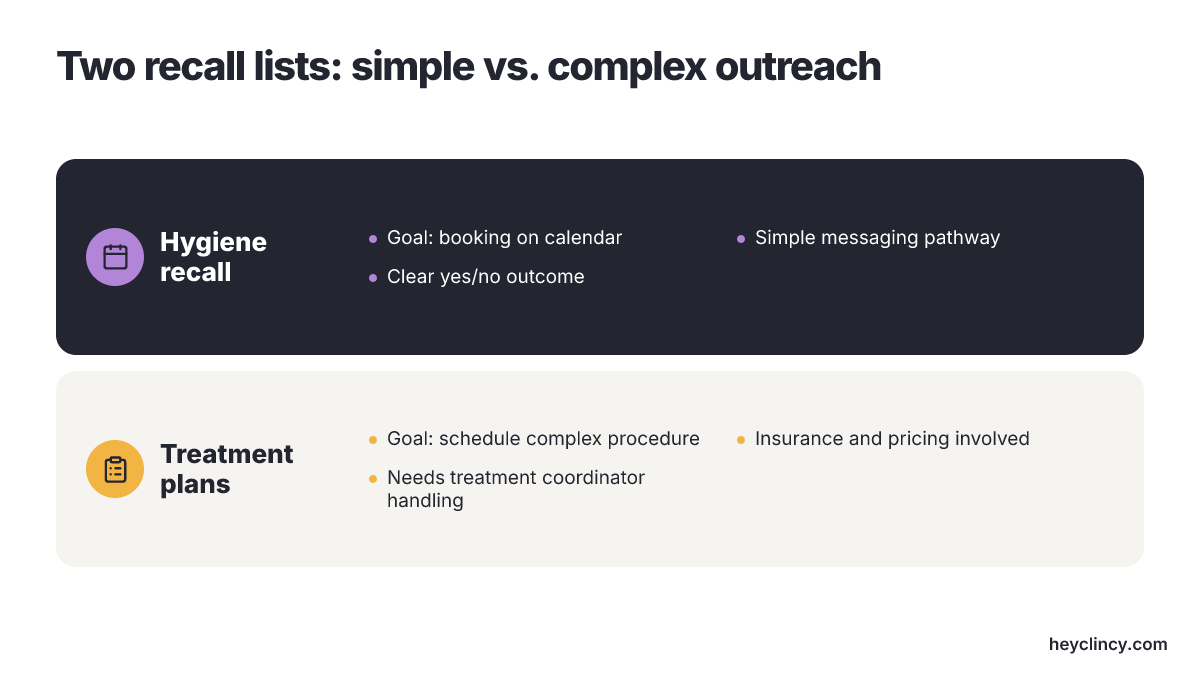
Dental practices in New York running Open Dental can check that structure with two lists: one overdue hygiene recall list and one unscheduled treatment plan list. The recall list is the simpler test, since the goal is a booking on the calendar. Treatment plans are messier because insurance co-pays and procedure steps come into play, and a senior treatment coordinator usually has to handle them. A service that sends the same generic note to both groups will push confused patients toward the wrong receptionist.
Front desk managers can use the same scorecard across vendors:
- Pull a narrow patient segment from Open Dental that the reception team knows well.
- Give the outside service approved scripts, open scheduling times, and clear rules for escalation.
- Ask the vendor to label each contact as booked, callback requested, declined care, unreachable, or bad contact data.
- Agree on a review window and track completed visits alongside bookings, unresolved replies and outbound attempts. Do not treat an outreach attempt as a completed appointment.
When calls and SMS messages come from separate systems, check whether staff can see earlier touchpoints before reaching out again. Ask for a shared communication record or a documented way to reconcile the systems. Use that record to investigate bad contact details, unanswered messages and unfinished callbacks rather than assume why outreach failed.
Set the response workflow before raising outreach volume. Ask every vendor how unanswered calls are logged, how requested callbacks reach the office and who closes each task. The explanation should be concrete enough for receptionists to understand what they would review and update during their normal work.
Clincy's pages cover dental patient reactivation and unscheduled treatment follow-up. For an Open Dental evaluation, ask the same questions used for the other candidates: what information the service reads, what it writes back, how patient replies reach a named treatment coordinator and what remains for office staff to finish. This article does not establish Clincy's integration performance or pilot outcomes.
Vendor descriptions can help shape an integration demonstration, but they are not independent proof of results. Dentalbase describes how DentiVoice identifies inactive patients and books appointments, and names Open Dental among the practice-management systems in its workflow. HeyGent Dental AI's vendor announcement describes an assistant that combines voice and text reactivation. Treat both as vendor-reported capabilities to test, not as independently verified performance. Ask each candidate to demonstrate scheduling handoffs, reply routing and duplicate-message handling in the setup your practice would actually use.
A solo practitioner in Washington should use these same operational filters, but a vendor's New York office address does not prove regional fit. Front desk teams still have to confirm patient messaging preferences, assign reply handlers, and set scheduling limits no matter where the company is based. Practices looking beyond their state lines can review other vendors through Clincy's list of services to reactivate dental patients. Teams that want to tighten internal messaging before hiring outside callers can review Clincy patient reactivation scripts to see which patient concerns need an immediate staff reply.
ClinAds works as a dedicated dental and medical clinic marketing agency, rather than a patient follow-up service. Evaluate any proposed advertising work against documented scope and reporting, without assuming that a marketing campaign will increase appointments or local visibility. Clinic directors should turn to ClinAds when the main goal is new patient acquisition or search visibility, not internal handling of overdue recall responses.
Handling patient outreach in-house without software still makes sense in some cases. A solo practice with a short recall list, a full daily schedule, and a receptionist who can set aside calling time every afternoon does not need an outsourced follow-up service. Consider outsourcing when replies, requested callbacks and chart updates remain unfinished, but compare that option with assigning clear internal ownership. A backlog alone does not establish that another vendor is necessary.
Choose by the follow-up task and test the handoff
Run a limited, practice-approved pilot before committing to a contract, using a patient segment and review window appropriate to your office. Export a single overdue hygiene segment from Open Dental, document scheduling parameters alongside escalation rules, and instruct the candidate service to show how patient replies convert into calendar bookings or documented chart notes.
Select a solution targeting the specific communication breakdown occurring at the front desk right now. When phone reminder tasks pull staff away from counter check-ins, hire dedicated caller support. When overdue dental hygiene requires specialized terminology, evaluate a dental-specific follow-up agency. When patient text replies sit unread across multiple disconnected portals, assign internal reply ownership before purchasing automation tools.
Third-party software cannot fix incorrect telephone numbers, unverified insurance data or front desk teams who neglect patient responses.
Safety boundary for follow-up campaigns: Keep routine recall and satisfaction surveys separate from clinical triage. Do not present an administrative callback queue as an emergency response service. Have the practice's clinical lead approve the instructions patients receive when they need urgent care and the escalation path callers use for concerning replies.
Test that routing before outreach begins, and make the queue's monitoring limits clear to staff and patients.
Frequently Asked Questions
What is the best patient follow-up service for a solo practice in New York?
There is no demonstrated overall winner in this comparison. Virtual Care Medical Services is a candidate for a solo New York practice with prepared lists and limited time for administrative outreach, subject to confirming the actual service scope. Before choosing it, ask how callers work with the practice’s records and how they report bookings, refusals, disconnected numbers and callback requests. Review a sample handoff report to make sure staff can monitor outcomes in their daily workflow.
Which patient follow-up service is best for reminder calls or dental recare?
HVAide lists reminder and follow-up calls within its healthcare administrative support services; confirm staffing location and availability rather than assuming a New York-based calling network. SoRa Dental Solutions is more focused: it serves dental offices whose main need is overdue hygiene recall. For either service, give callers clear, segmented instructions. Dental practices should also provide vetted patient lists and set boundaries for questions that need an in-house treatment coordinator.
What should a solo practice confirm before outsourcing patient follow-up calls?
Clarify how patient replies, call outcomes and scheduling requests will reach the practice, and identify who reviews them each day. Agree on how callers record bookings, refusals, disconnected numbers and callback requests. Also establish list criteria, scripts, priorities and scheduling boundaries before outreach starts. The article emphasizes that outside calling only helps when completed conversations enter a workflow clinic staff actually monitor.
Is Yosi Health a good choice for patient follow-up?
Yosi Health lists surveys, text communication and check-in workflows; evaluate it for digital patient communication rather than assume it offers manual recall calling. Confirm survey timing, response routing and reporting in the package under consideration. Before adopting it, decide who will review responses daily and ask how alerts and internal task assignments work. Dental practices should verify how overdue recall targets are handled and whether responses can become scheduled appointments.
Related reading
- 6 Best Dental Recall Services for Small Texas Practices
- 6 Services to Reactivate Dental Patients in the USA
- 6 AI Answering Services for Florida Multi-Site Practices
- Top SEO Options for Solo Medical Practices in Pennsylvania
- SEO Services for Doctors' Offices: The 2026 Playbook to Own the Local Map Pack
Sources
Clincy keeps treatment conversations moving with personalized texts, human support, and scheduling in your practice management system.
Book CallMore from the blog
3 Best Dental Two-Way Texting Tools by Workflow
Compare texting tools on recall ownership, unscheduled treatment follow-up, and Open Dental handoffs, so replies become scheduled next steps.
Best Patient Reactivation Tools for Dental Practices
Compare dental reactivation software by reply handling, booking workflow, pricing model, and Open Dental fit, with practical checks for your vendor demo.