6 AI Answering Services for Florida Multi-Site Practices
Compare six Florida AI answering services for multi-location practices, with handoff checks, booking risks and reactivation fit for dental teams.
Summary: For multi-location practices in Florida, Visiologic and Clinic Front AI are top contenders for AI answering services. Visiologic offers multi-site voice coverage, and practices should test how directly it syncs with systems like Open Dental, while Clinic Front AI provides specialized dental and medical call handling. Both services prioritize effective call routing and patient management, essential for reducing front desk workload and improving patient experience.
An incoming call rings at the Tampa desk while a hygiene room in Orlando opens after an unexpected cancellation. At that same moment, a patient phoning about overdue periodontal care reaches an empty line. The treatment coordinator is behind a closed door with a case. Two walk-ins are standing at the desk. The caller gives up and hangs up, and nobody matches the open chair with the person who wanted it.
Evaluating the best AI answering service for multi-location practices in Florida means looking past conversational polish.
Natural inflection means very little if the software sends the call to the wrong front desk, drops clinical context, or leaves the local team with an unassigned callback task. Dental groups running three or more Florida locations protect production by putting routing logic and scheduling rules ahead of vocal tone. When an automated voice agent books the wrong provider, triggers redundant recall messages, or records notes outside Open Dental, it creates extra administrative work instead of clearing the desk.
1. Visiologic: multi-location voice coverage
Visiologic AI voice receptionist offers an automated voice answering layer built for multi-location enterprises, including outpatient medical and dental clinics.
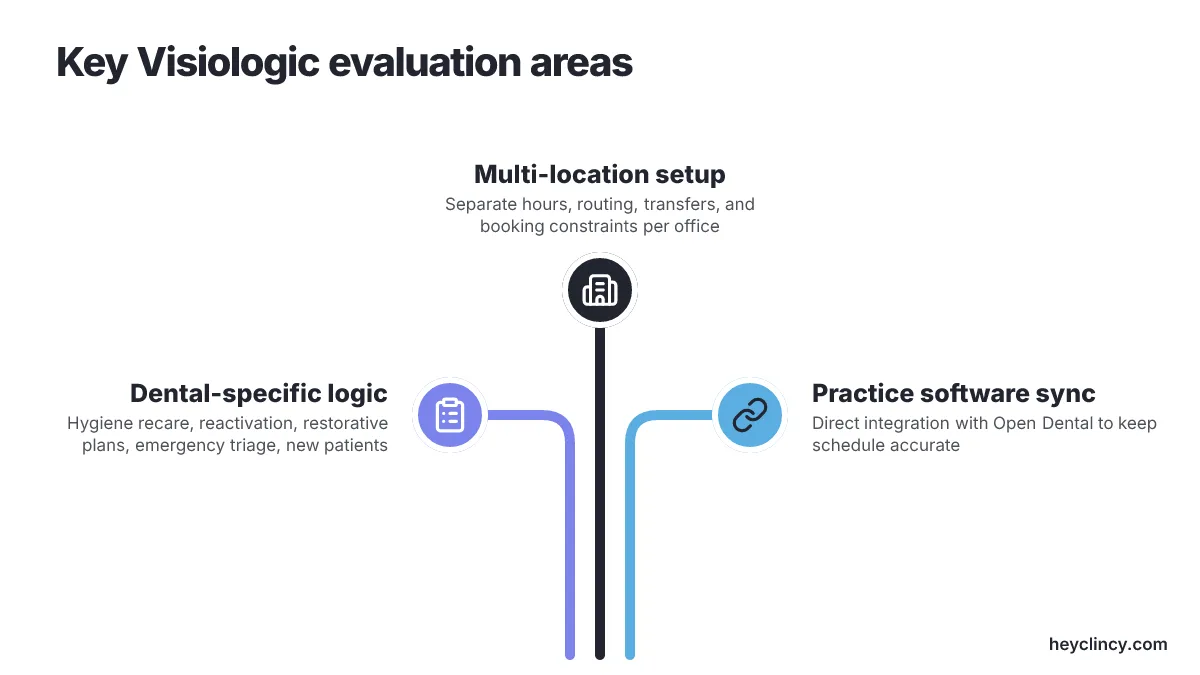
Practices with regional footprints get the most value when they need unified phone coverage across several sites from a provider whose core architecture targets multi-facility operations, not single-doctor offices. Regional groups should review Visiologic when ringing lines interrupt daily clinic workflows, especially during peak morning check-ins and late-afternoon schedule adjustments. Operational managers need to confirm during discovery whether the platform lets individual offices set separate hours, routing tables, emergency transfers, and chair-specific booking constraints.
The critical assessment area centers on dental-specific operational logic. Visiologic positions its answering system across broad healthcare environments, but a dental practice must verify that the engine separates routine hygiene recare, overdue reactivation, unscheduled restorative plans, emergency triage, and first-time patient registrations. Clinics must also test how directly Visiologic syncs data with practice software like Open Dental to keep the schedule accurate without manual data entry.
2. Clinic Front AI: dental and medical call answering
Clinic Front AI patient calls is managed by MCAI Consulting in Miami, and it handles patient communications for medical and dental facilities.
This dental focus helps practice administrators who need automated call handling shaped around clinical terminology rather than generic customer support scripts. Office teams should evaluate Clinic Front AI when front desk staff are buried in daytime call volume and patient check-ins, not just when they want an overnight voicemail recorder. Multi-site groups should prepare difficult scenarios for the first demonstration, such as a delinquent hygiene patient asking for a morning slot, a caller with questions about a crown pre-authorization, or a parent booking two siblings during school breaks.
Live call management does not replace an end-to-end reactivation pipeline. Practice leaders must verify where call summaries post, which team member receives the notification, and whether the coordinator sees previous contact history to prevent duplicate outreach from another staff member. Group administrators also need to audit how Clinic Front AI isolates protected health information across locations to comply with HIPAA security mandates.
3. Hire Rita: med spa and aesthetics reception
Hire Rita AI receptionist provides automated phone reception built for aesthetic practices and med spas from its base in Miami.
Healthcare or dental clinics whose call volume resembles retail aesthetics, such as clear aligner consultations, teeth whitening inquiries, and straightforward schedule coordination, will find the closest operational match here. Offices handling heavy inbound inquiries from retail-driven marketing campaigns can use Hire Rita to capture booking demand quickly. Dental staff still need to verify how the software answers insurance network questions, procedure prerequisites, and record lookups for established patients without offering unauthorized clinical or financial commitments.
Selecting an answering engine because of pleasant vocal cadence alone creates back-office bottlenecks. When the main revenue leak comes from hundreds of overdue recare charts and pending treatment plans in Open Dental, an aesthetics-focused voice tool needs strict escalation boundaries before it handles recall conversations. Administrators must examine whether Hire Rita allows detailed script changes to match clinical terminology and distinct location policies.
4. Revyra: multi-location rollout planning
Revyra AI call answering works from Miami and handles call reception for multi-site groups with phased onboarding. Practices that want a slow rollout, rather than a risky switch across every clinic at once, will value that setup.
Phased rollouts help keep operations steady. Phone systems across several offices create friction at the handoff points, especially when each clinic has different hours, different doctor schedules, different fee schedules, and rotating admin coverage. Start with one location, then tighten the transfer rules, call summaries, and emergency flags before you spread the setup to the rest of the branches.
Group leaders still need to ask what kind of admin control comes with line provisioning. Dental executives should find out who changes prompts, who reviews site-specific replies, how dropped calls get checked, and how incoming patient requests become tracked tasks for the local treatment coordinator. Clinical groups should also look at Revyra's staff training support, since decentralized front desk teams need it if the system is going to hold up day after day.
5. Buster Digital Media: medical practice phone agent
Buster Digital Media phone agent runs an office in Miami and offers conversational voice agents for healthcare practices. Medical and dental groups that want an answering service from a company familiar with online search marketing and digital intake paths fit the target user base.
Practice leaders should treat Buster Digital Media as an inbound phone answering tool, not a reactivation engine. A dental practice manager should test whether the system records caller intent, matches existing charts, and sends the message to the right office inbox without creating vague web forms that slow down the front desk.
Keeping patient acquisition separate from call handling makes software reviews more honest. Clinads AI-powered marketing team is a dental and medical clinic marketing agency that builds, manages, and optimizes campaigns to book patients and improve local visibility, while an answering agent must turn incoming callers into scheduled production. Practices should look closely at how Buster Digital Media connects digital ad campaigns with front desk schedules so patient retention stays strong.
6. WorkGentic: appointment booking for practices
WorkGentic AI receptionist is a conversational voice platform built in Jacksonville that answers clinical phone lines and books appointments onto the schedule. That direct booking function fits clinics that lose production because calls go unanswered during lunch hours and other admin peaks.
Groups that want appointment placement, not just call logging, should put WorkGentic on the evaluation list. Dental administrators need clear scheduling rules before deployment. They have to decide which clinician columns allow direct entry, which complex procedures require staff screening, which calendar blocks stay locked, and how urgent emergencies move to on-call providers.
Controlled scheduling works best with narrow visit types. An office manager can let the system book routine six-month prophy visits, while unscheduled crown or bridge callbacks go to a treatment coordinator who can handle co-pays and insurance limits. Dental teams should confirm how WorkGentic blocks overlapping bookings and records cancellations so chair utilization stays predictable.
How should a multi-location dental practice choose an AI answering service?
Clinical administrators should structure software evaluations starting from the team handoff and working backward to the incoming call. Natural vocal inflection matters far less than what takes place after a patient accepts an opening, poses a coverage question, or requires a direct callback from an insurance specialist.
Recent market updates highlight why clinic buyers must define software boundaries precisely. In October 2026, Dental Intelligence stated DI Voice supports multiple locations in one account and routes calls to AI Receptionist, creating consolidated phone infrastructure for multi-site dental groups. In August 2026, Annie announced its recare and confirmations expansion to incorporate cancellation rebooking and real-time insurance verification, extending automation deeper into core operations.
Cross-industry voice tools are also accelerating their entry into clinical front offices. In July 2026, Zoom announced a standalone AI receptionist launch priced from $29.99 monthly for 100 minutes, designed as an add-on for existing telephone setups. In June 2026, Dental Intelligence announced a national AI Receptionist launch operating around the clock to address routine clinic questions and handle scheduling requests across common VoIP setups.
Multi-location organizations must separate four distinct communication responsibilities before selecting software:
- Live call answering captures overflow rings, after-hours basic inquiries, line transfers, and general clinic questions.
- Direct booking places patients directly into predetermined calendar slots that practice leaders clear for automated scheduling.
- Patient reactivation targets delinquent charts requiring outbound attempts, reply parsing, phone callbacks, and updated status logs.
- Unscheduled treatment follow-up manages patients who received diagnosed treatment plans and require coordinator guidance on financing or clinical sequencing.
Clincy is building AI calls and texts for dental patient reactivation and unscheduled treatment follow-up, with Open Dental as its initial pilot focus. The distinction matters because a voice receptionist can catch a call, while a reactivation workflow has to work from overdue patients, prior outreach, patient replies, and the practice's own Open Dental follow-up process.
Live demonstrations should involve actual operational edge cases rather than scripted vendor presentations. Require the answering software to process an overdue prophy patient wanting an urgent morning appointment, an existing patient asking questions about an old root canal quote, an individual requesting an immediate text messaging opt-out, and an unverified caller attempting to book complex cosmetic treatment without clinical clearance.
Having an office in the same state is less important than proving the software respects distinct branch hours, escalation hierarchies, security requirements, and booking rules.
Single-doctor offices operating one phone line with a disciplined front desk team that contacts every missed call promptly may find automated answering premature. These clinics can validate outreach messaging using Clincy Dental Patient Reactivation Scripts to determine whether unbooked chairs stem from call capacity, outreach timing, or front-desk task delegation.
Multi-office practices should require every candidate platform to demonstrate five core capabilities before contracting:
- Prove that every facility maintains distinct operational hours, greeting options, and routing logic.
- Document how the caller's specific intent gets recorded and assigned to the local front desk or treatment coordinator.
- Confirm compliance mechanisms for recording opt-out requests and patient communication preferences.
- Verify guardrails preventing unvetted bookings for clinical procedures that mandate prior administrative review.
- Demonstrate reporting systems tracking attended patient visits rather than simply counting answered calls.
Lower-cost answering tiers serve clinics well when the sole requirement involves capturing late-evening messages or handling lunchtime overflow. Higher-priced platforms justify their cost only when they eliminate administrative rework, assign clear accountability for every patient reply, and secure productive chair time without disrupting the schedule.
How to roll out an AI answering service across locations
Start the voice service at one branch first, and keep it tied to one call type the staff already knows how to handle. Pick a single person on the team to receive every handoff. If you try it on after-hours prophy requests or overflow lines, you can catch technical snags before they spill into unscheduled treatment callbacks, where clinical details and insurance copays need a coordinator's attention.
Bring the location schedules, call flow charts, appointment restriction tables, and Open Dental setup to the first vendor review. Ask for a full demonstration that shows how a patient call turns into a front desk task, with clear staff ownership attached. Stop there if the vendor cannot show verified task handoffs inside your current software, because a missed message in a separate dashboard still means a lost appointment, no matter how fast the calls get answered.
Frequently Asked Questions
What are the best AI answering services for multi-location practices in Florida?
Visiologic and Clinic Front AI are highlighted as top contenders for multi-location practices in Florida. Visiologic offers multi-site voice coverage, and practices should test how directly it syncs with systems like Open Dental, while Clinic Front AI specializes in dental and medical call handling, focusing on effective call routing and patient management.
How does Visiologic support multi-location dental practices?
Visiologic provides an automated voice answering layer designed for multi-location enterprises, offering unified phone coverage across several sites. Practices should test how directly it syncs with practice management software like Open Dental to keep the schedule accurate without manual data entry, and confirm whether individual offices can set separate hours and routing tables.
What makes Clinic Front AI suitable for dental and medical facilities?
Clinic Front AI is managed by MCAI Consulting in Miami and focuses on automated call handling shaped around clinical terminology. It suits practices with high daytime call volumes and patient check-ins, and practice leaders should verify where call summaries post and whether previous contact history is visible to prevent duplicate outreach.
How does Hire Rita cater to med spa and aesthetics practices?
Hire Rita offers automated phone reception tailored for aesthetic practices and med spas. It is suitable for clinics with call volumes similar to retail aesthetics, such as inquiries about clear aligners and teeth whitening. However, dental staff must verify how the software handles insurance questions and clinical terminology.
What should practices consider when evaluating WorkGentic for appointment booking?
WorkGentic is designed for clinics that need direct appointment booking to prevent lost production due to unanswered calls. Practices should establish clear scheduling rules, such as which clinician columns allow direct entry and how urgent emergencies are handled, to ensure predictable chair utilization and prevent overlapping bookings.
How does Revyra help multi-location groups roll out call answering?
Revyra handles call reception for multi-site groups with phased onboarding, so a practice can start with one location, tighten transfer rules, call summaries and emergency flags, and then extend the setup to the other branches. Group leaders should ask who changes prompts, who reviews site-specific replies and how dropped calls get checked.
Is Buster Digital Media a patient reactivation tool?
No. Buster Digital Media offers conversational voice agents for healthcare practices and is best treated as an inbound phone answering tool, not a reactivation engine. A dental practice manager should test whether it records caller intent, matches existing charts and sends the message to the right office inbox.
Does a single-location dental office need an AI answering service?
Not always. A single-doctor office with one phone line and a disciplined front desk team that returns every missed call promptly may find automated answering premature, and can first check whether unbooked chairs come from call capacity, outreach timing or front-desk task delegation.
Related reading
- 6 Best 6 AI Vendors for Dental Treatment Reactivation
- 6 Services to Reactivate Dental Patients in the USA
- 6 Best Dental Recall Services for Small Texas Practices
- AI Technologies Revolutionizing Dental Imaging by 2026
- 6 Best AI Systems for Clinics in Florida, Reviewed
- Your Telemedicine Patients Are Vanishing Into AI Overviews. The Fix Is Not More Blog Posts.
Sources
Clincy keeps treatment conversations moving with personalized texts, human support, and scheduling in your practice management system.
Book CallMore from the blog
Top Dental Recare Systems for Practice Management
Compare four dental recare systems (Open Dental, Dentrix, Eaglesoft, Curve Dental) by integration, two-way SMS and recall tracking, plus how to choose one.
Dental Patient Intake Solutions: Weave vs Solutionreach
Compare Weave and Solutionreach on digital forms, Open Dental handoff questions, and where intake ends before reactivation follow-up starts.