6 Best Dental Recall Services for Small Texas Practices
Compare six dental recall services on Texas fit, Open Dental questions, and reply handoffs so overdue patients become booked visits without extra queues.
Summary: For small dental practices in Texas, the best recall service depends on specific needs. RevenueWell is ideal for integrating recall with the full appointment lifecycle. PracticeDilly offers relief for small staffs by automating recalls. PatientXpress suits solo practices with simple automation needs. Adit provides local vendor presence in Texas.
A patient sends a text at 8:15 AM to book an overdue hygiene visit, and two people are already at the front desk while the office phone rings with an urgent toothache call. That text sits untouched in a web portal until late afternoon. Tomorrow's hygiene chair stays open because staff were tied up with people in the office. Finding the best dental recall service for small practices in Texas means fixing that handoff, not sending more messages into the dark.
Our directory tracks 3,399 dental clinics across 1,038 cities as of November 2026. That means patients who drift off the hygiene schedule have plenty of other offices to call. Outreach creates real overhead once an overdue patient replies and nobody at the front desk knows who takes the next step, the hygienist, a treatment coordinator, or the receptionist who happened to answer first.
Automated recall software pays off only when replies turn into clear next actions inside your main clinical schedule. The first platform worth testing sends every response to one accountable team member and records the outcome in Open Dental or your core practice management database.
1. RevenueWell: best for appointment lifecycle coverage
The RevenueWell recall platform works for a dental office that wants recall messages tied to the wider patient visit flow, not trapped inside a separate texting program. RevenueWell says its system includes recall and reactivation automation built to keep the schedule full, so it fits offices that want routine recall outreach along with intake paperwork and appointment confirmations.
Putting patient communication into one system makes sense when front-office staff already juggle several software portals. Practice leaders looking at this setup should check how incoming messages return to the clinical schedule, which team members get alerts, and what keeps hygiene coordinators and treatment schedulers from texting the same chart that morning.
Running a full-lifecycle platform takes more setup than a light texting tool, and that is the main trade-off. Broad communications can be worth it when an office actually uses intake and review features. If the office only needs to fill empty cleaning slots, a dedicated recall tool may be quicker to launch.
2. PracticeDilly: best for small-staff recall relief
Running PracticeDilly automated recalls helps small teams that need daily patient outreach to take less staff time. PracticeDilly shares feedback from compact dental teams showing automated scheduling and recall contact saves hours every week, which gives real relief to front desks where outbound calling keeps losing to walk-ins and billing calls.
This software fits an office where the problem is execution, not figuring out who needs care. Administrative workers usually know which charts are overdue for six-month exams, but they do not have the phone time to dial numbers, write text messages, track voicemails, and type status notes into the schedule during clinic hours.
Checking this tool means looking at task ownership before you worry about message wording. Small administrative teams need to see where an incoming confirmation appears, how the system flags patients asking for a quick callback, and whether a receptionist can view the latest automated text before answering the phone.
3. PatientXpress: best for solo and independent practices
Choosing PatientXpress dental recall software gives solo dental offices automated outreach without buying complex enterprise management software. PatientXpress says its features are built for solo and independent practices, combining automated appointment reminders with follow-up sequences so front-office teams spend less time chasing hygiene charts by hand.
Private practitioners who want steady schedule filling without changing every office routine will find a practical balance here. The strongest use case is an office where lists of unscheduled hygiene patients sit unused in the database and staff need predictable message delivery with a clear daily review queue.
Checking how it works still calls for the same scrutiny used with larger software suites. Practice owners should verify how the system tracks patients who need voice calls, how opt-out requests are recorded, and how a completed cleaning visit gets credited back to the original automated campaign.
4. Adit: best for a Texas-based vendor presence
Choosing Adit patient recall software means getting automated patient messages from a software company based in Texas. Adit lists corporate offices at 7324 Southwest Fwy Ste 1460, Houston, Texas, and it offers reminder workflows meant to keep chairs occupied without forcing reception staff into nonstop manual follow-up.
Some practice owners like working with a vendor in the same state. That kind of proximity can matter during software selection and onboarding. A Houston address does not prove the software works better, but it does give Texas dental offices a shared time zone for support calls, setup meetings, and staff training.
The platform still needs a closer look than the mailing address. Office managers should check how the automated contact loop stops after a patient books, how missed texts are shown, and whether recall work stays separate from unscheduled treatment follow-up.
5. 10x Dental: best for AI voice, text, and email recall
Using 10x Dental AI recall fits practices that want artificial intelligence to contact overdue patients through more than one channel. 10x Dental presents an AI recall system for dental teams that uses voice AI, texts, and emails to work through unscheduled hygiene lists each day and fill hygiene appointments.
Voice AI only works well when the office sets firm rules for harder conversations. Clinical staff need a plan for the patient who asks about insurance benefits, wants a certain hygienist, mentions tooth pain, or asks about an unfinished crown instead of a routine cleaning.
Practice administrators should ask for full call recordings, written summaries of each conversation, tight scheduling limits, and a clear path for calls that need a human response.
6. NexHealth: best for EHR confirmation updates
Installing NexHealth dental recall systems helps dental teams that want live schedule changes reflected inside their main electronic record system. NexHealth describes a patient communication process that includes automated notices, adjustable outreach timing, and confirmation updates that populate inside the connected EHR database.
That setup matters for growing practices because staff can see status changes right away across shared clinical screens. A Texas clinic linking this software to its management database should check which appointment fields update on their own, how pending patient messages appear, and how last-minute cancellations show up after the first outreach sequence ends.
This vendor should be judged on data accuracy, not message volume. Front-desk staff need full trust in the schedule status, because bad syncing creates extra calls for visits that the team thought automation had already confirmed.
How should a small Texas practice choose a recall service?
Selecting the right platform requires checking reply ownership, practice management writeback, and patient list segmentation before evaluating communication channels. Phone calls, texts, and emails help reach patients, but communication fails when incoming replies lack designated staff owners or when visit updates fail to write back to Open Dental.
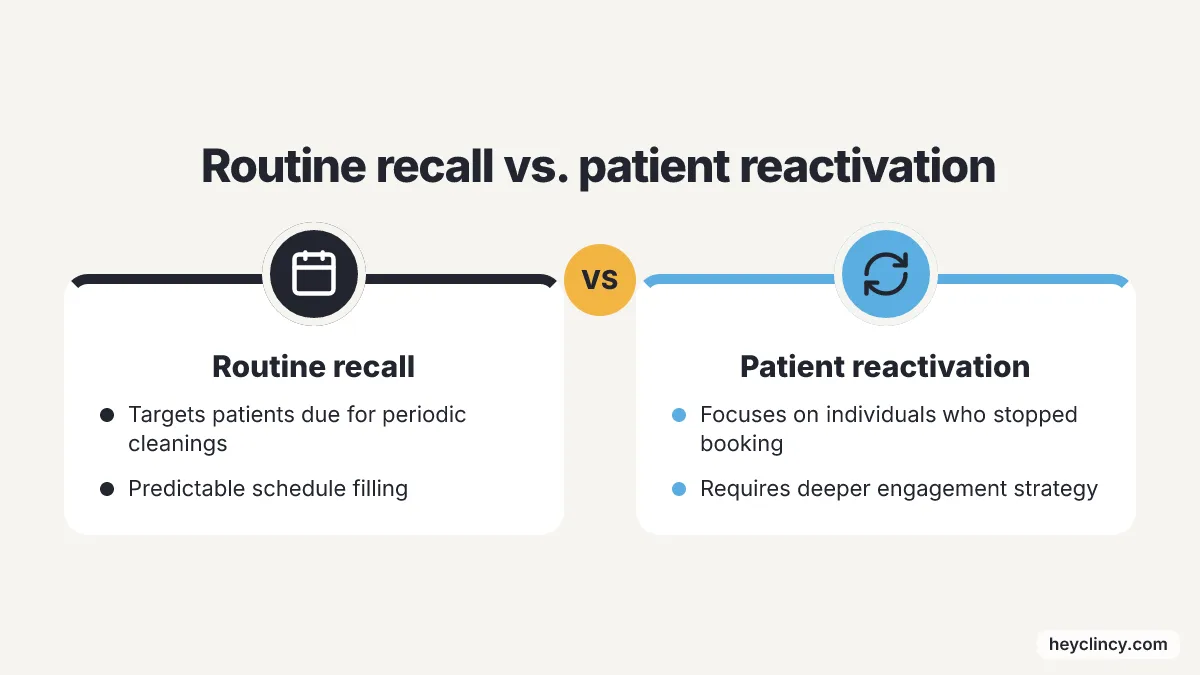
Separating routine preventive recalls from deep patient reactivation must happen before booking software demonstrations. Routine recall targets patients due for periodic cleanings, while reactivation focuses on individuals who have stopped booking care entirely; teams balancing these workflows can examine the operational boundaries between recall versus reactivation prior to launching any pilot.
Offices running Open Dental should require vendors to verify exact version compatibility rather than accepting vague claims of software integration. Open Dental announced in August 2026 that its Version 26.1 stable release became the production standard on 08/06/2026, while Open Dental confirmed that same month that its Version 26.2 beta release introduced updated API capabilities and automation triggers, meaning vendors must specify which software build their tool supports.
Setting up clear staff responsibilities must occur before broadcasting the first outreach message. A practical protocol designates who books incoming appointment requests, who answers clinical questions, who handles callback alerts, and who updates the patient record after an appointment takes place.
Preventing message duplication requires its own operational rules because automated reminders, front-desk calls, and treatment planning messages frequently target the same chart simultaneously. If your practice already sees team members crossing paths on outbound outreach, establishing an ownership framework is essential, and teams can adopt practical safeguards against duplicate dental recall messages.
Patient fatigue is prevented by halting outreach immediately after an individual responds, honoring communication preferences, and silencing future reminders once an exam is scheduled. Marsad Group reported in July 2026 that the Seventh Circuit determined in Steidinger v. Blackstone Medical Services that text messages do not constitute telephone calls under TCPA Section 227(c), though the legal analysis emphasized that medical practices must still maintain documented consent for automated patient messaging.
Payer mix considerations across Texas influence projected collections from overdue patient outreach. The Texas Medicaid & Healthcare Partnership and the Texas Health and Human Services Commission published August 2026 fee-for-service payment schedules following a May 26, 2026 rate hearing covering 47 dental procedure codes, taking effect for service dates starting September 1, 2026, meaning offices with significant Medicaid enrollment should calculate recall profitability using these updated reimbursement rates.
Small dental offices in Missouri can apply these exact selection criteria, substituting local payer fee structures and regional support details for Texas data points. The most effective recall system for a small clinic in Missouri remains the software that demonstrates message assignment, real-time database syncing, opt-out management, and verified chair attendance within daily clinical operations.
Manual outreach remains the better option under one specific operating condition: an office managing a small inactive patient registry with full front-desk staffing and same-day phone follow-up should not purchase automation software. Paid recall tools require setup time, monthly software fees, and oversight, making manual calling the more sensible financial choice until unworked patient replies consistently outstrip front-desk capacity.
Testing conversation scripts manually prevents scaling awkward wording across hundreds of patients. Front-office coordinators can adapt Clincy dental patient reactivation scripts for unscheduled charts to evaluate how the messaging reads across phone calls, text messages, and email touches.
Unresponsive charts need a different handling process than patients who ask to postpone care. Practices accumulating non-responsive charts must define intervals for pausing outreach, varying contact methods, and ending follow-up, using a documented process to manage patients who do not respond.
Reviewing the broader vendor marketplace can also reveal newer technologies entering the clinical field. The DDS Vendors network operates as an invite-only dental community highlighting vetted early-stage technology companies and advisory connections before products appear at major dental conventions, giving practice leaders visibility into new diagnostic tools, artificial intelligence systems, and clinical automation.
Clincy is building AI calls and texts for dental patient reactivation and unscheduled treatment follow-up, with Open Dental as its initial pilot focus. Clincy is most relevant when the practice wants overdue patient outreach and unscheduled treatment follow-up handled with clear handoffs rather than another unmonitored queue.
Software evaluations should conclude with practical operational testing rather than generic feature presentations. Ask every vendor to process a real overdue-chart scenario, display the outbound message, track the inbound patient response, assign the follow-up task to a staff member, and write the final appointment status into the practice database.
Conclusion: how to pilot a recall service
Isolate the overdue patient list causing the most daily confusion at your front desk, then test a recall service against that single roster before expanding outreach across the entire database. Running a controlled pilot requires an audited contact list, explicit rules assigning incoming replies to named staff members, recorded communication consent, and a method to track whether re-engaged patients actually show up for treatment.
Schedule a live workflow demonstration with shortlisted vendors using your current booking intervals, provider schedules, and Open Dental configuration. Discontinue discussions with any vendor that cannot show where patient replies land, how duplicate texts are blocked, or how completed appointments write back to the schedule. Focus your effort on establishing a thirty-day pilot with one accountable team member managing incoming responses.
Frequently Asked Questions
What is the best dental recall service for integrating with appointment lifecycle?
RevenueWell is ideal for integrating recall with the full appointment lifecycle. It ties recall messages to the wider patient visit flow, making it suitable for offices that want routine recall outreach along with intake paperwork and appointment confirmations.
Which dental recall service is best for small dental teams in Texas?
PracticeDilly is best for small dental teams as it automates recalls and saves hours every week. It provides relief to front desks where outbound calling often loses to walk-ins and billing calls, making it ideal for offices where the problem is execution rather than identifying who needs care.
What recall service should solo dental practices in Texas consider?
Solo dental practices in Texas should consider PatientXpress, which offers automated outreach without complex enterprise management software. It combines automated appointment reminders with follow-up sequences, providing a practical balance for private practitioners who want to fill schedules without changing every office routine.
Why might a Texas dental practice choose Adit for recall services?
A Texas dental practice might choose Adit because it is a Texas-based vendor, offering proximity that can be beneficial during software selection and onboarding. Adit provides automated patient messages and reminder workflows to keep chairs occupied without forcing reception staff into nonstop manual follow-up.
How does 10x Dental utilize AI for dental recall services?
It works through unscheduled hygiene lists each day to fill appointments. However, it requires firm rules for conversations and a plan for handling patient inquiries about insurance, specific hygienists, or other non-routine issues.
Which dental recall service is best for EHR confirmation updates?
NexHealth suits dental teams that want live schedule changes reflected inside their main electronic record system. It describes automated notices, adjustable outreach timing, and confirmation updates that populate inside the connected EHR database, so it should be judged on data accuracy rather than message volume.
Do small dental practices in Missouri need a different recall service?
Small dental offices in Missouri can use the same selection criteria as Texas practices, substituting local payer fee structures and regional support details. The right recall system is the one that demonstrates message assignment, real-time database syncing, opt-out management, and verified chair attendance.
When is manual recall outreach better than recall software?
Manual calling makes more sense for an office with a small inactive patient registry, full front-desk staffing, and same-day phone follow-up. Paid recall tools require setup time, monthly software fees, and oversight, so automation pays off once unworked patient replies consistently outstrip front-desk capacity.
Related reading
- Prevent Duplicate Dental Recall Messages: A 2026 Guide
- What to Do When Dental Patients Don't Respond to Recall
- Top High-Risk Pregnancy OB/GYN and MFM Clinics in Texas
- Evaluating Dental Recruiting Agencies for Hygienists
- Top 6 Texting Tools for Dental Offices: Ranked by Recall
Sources
Clincy keeps treatment conversations moving with personalized texts, human support, and scheduling in your practice management system.
Book CallMore from the blog
Dental PMS Integration: 6 Best Options for Recall Work
Compare six dental PMS integrations for recall work by platform coverage, Open Dental fit, and follow-up workflow so overdue patient outreach reaches a clear owner.
6 Services to Reactivate Dental Patients in the USA
Explore six dental patient reactivation services focusing on PMS integration, channel mix, and monthly cost. Learn three checks to avoid a bad fit.