Dental PMS Integration: 6 Best Options for Recall Work
Compare six dental PMS integrations for recall work by platform coverage, Open Dental fit, and follow-up workflow so overdue patient outreach reaches a clear owner.
Summary: Dental PMS integration is crucial for effective recall and reactivation work, transforming follow-up tasks into real patient interactions. The best integration ensures seamless communication, updates outcomes in systems like Open Dental, and prevents the front desk from managing multiple queues. Top options include Pearly for broad PMS coverage, CRMBridge.ai for unified API integration, and TensorLinks for major platform connectivity.
An overdue patient returns a text about a cleaning, another replies to a crown estimate, and the front desk phone rings before anyone records either outcome in Open Dental. The hygienist schedule has openings, the treatment coordinator is with a patient, and the same family is about to get a second message from someone else.
Dental PMS integration matters most when follow-up work leaves the recall list and becomes a real patient conversation. For reactivation and unscheduled treatment, the best integration is not the one with the longest platform logo wall, it is the one that gives one owner a clean next step, writes back the outcome, and keeps outreach from becoming another queue the front desk has to police.
The ranking below weighs PMS coverage, Open Dental relevance, and how directly each option supports recall, reactivation, scheduling, or the vendor selection work around those jobs. Breadth matters, but a broad connector that does not fit the office workflow still leaves overdue patients sitting in the same place.
1. Pearly: broad ledger-level PMS coverage
Pearly is the strongest fit when a dental group wants broad PMS coverage and needs integration at the ledger level, because Pearly states that it connects with 80+ dental practice management systems, including Dentrix, Open Dental, and Eaglesoft. Ledger-level connectivity matters for recall and reactivation work when balances, completed treatment, and patient account history affect what the front desk says next.
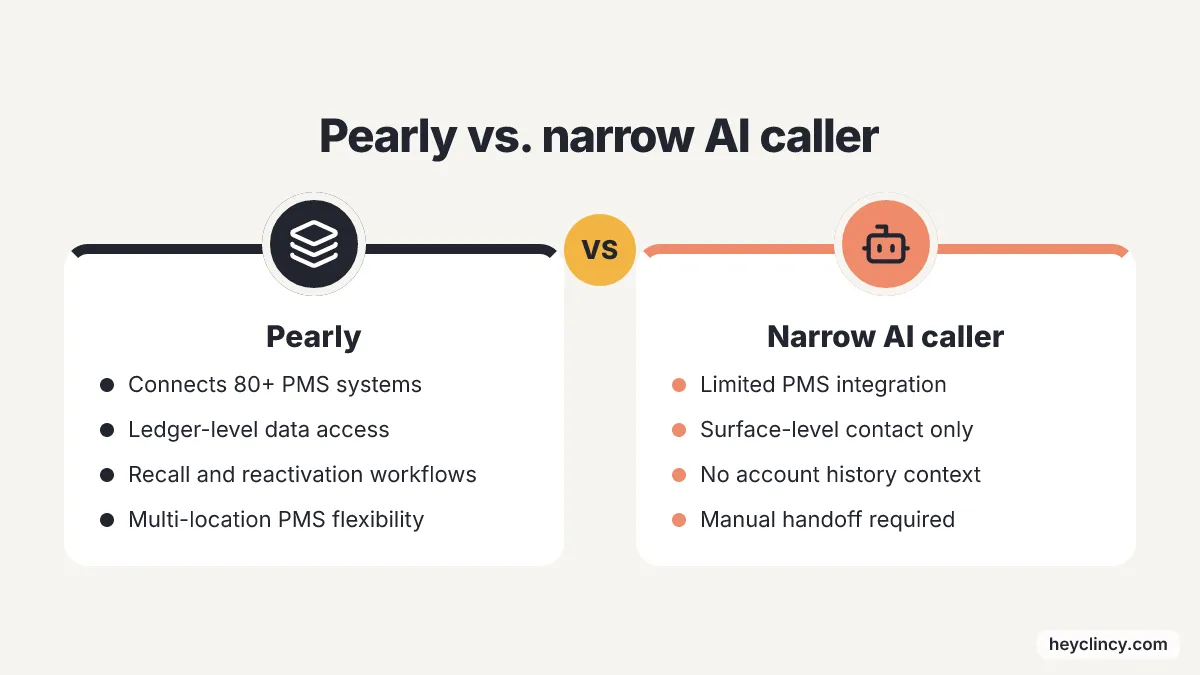
Pearly suits practices or small groups that do not want to rebuild follow-up logic every time a location uses a different PMS. An Open Dental office gains from the named compatibility, while a mixed-PMS group gains from the wider system count.
Pearly is not automatically the right choice for a practice that only needs a narrow AI caller or SMS follow-up workflow. A high-coverage integration still needs a clear handoff rule for replies, appointment requests, and patients who need a live coordinator before they schedule.
2. CRMBridge.ai: unified API coverage across practice software
CRMBridge.ai fits teams building or buying around a central API, because CRMBridge.ai describes itself as a unified practice management integration API for dental, veterinary, and chiropractic software. CRMBridge.ai states that its HIPAA-compliant REST API connects Dentrix, Eaglesoft, Open Dental, Cornerstone, AviMark, ChiroTouch, and 40+ practice management systems, which makes it broader than a dental-only point integration.
CRMBridge.ai suits a practice group, vendor, or operations team that wants one integration layer behind multiple tools. For a dental office manager, the practical question is whether the tool sitting on top of the API turns patient replies into a scheduled visit, a treatment coordinator task, or a documented no-response outcome.
CRMBridge.ai ranks high because API breadth lowers the cost of changing front-end tools later. The trade-off is that an API is not the workflow itself, so a practice still needs implementation discipline, field mapping, and ownership rules inside the PMS.
3. TensorLinks: major PMS platform connectivity
TensorLinks is a strong option when the job is connecting with the major dental PMS platforms rather than chasing every smaller system. TensorLinks lists integrations with Dentrix Ascend through Henry Schein One API Exchange, Dentrix, Eaglesoft, Open Dental, Curve Dental, Denticon, and CareStack, giving it practical coverage across the systems many independent and growing practices encounter.
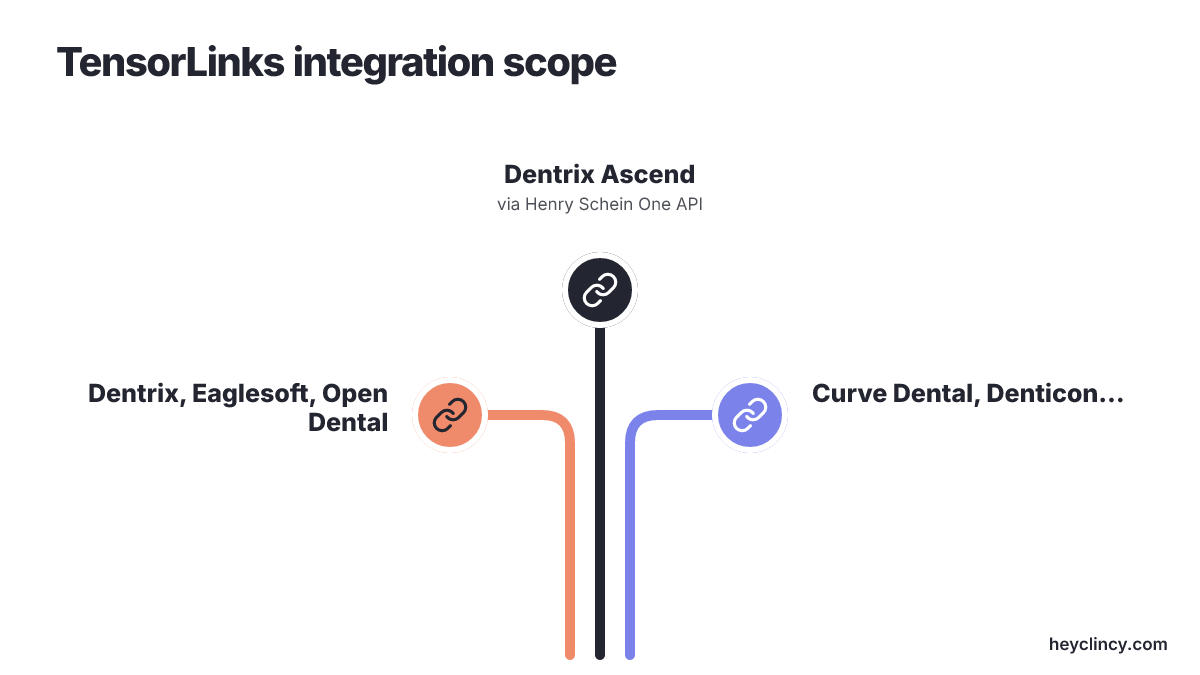
TensorLinks suits a practice evaluating integration infrastructure for scheduling, patient communication, or operational software that must work across established PMS environments. The inclusion of Open Dental puts it on the shortlist for offices that want overdue patient and unscheduled treatment workflows connected to the system where patient status already lives.
TensorLinks ranks below Pearly and CRMBridge.ai for this specific search because the TensorLinks integrations page supports major-platform coverage rather than the same numerical breadth. Major-platform coverage is still enough for many practices, especially when the integration work is tied to a defined follow-up workflow.
4. PatientXpress: CRM marketplace connection for dental PMS users
PatientXpress fits practices already thinking about CRM workflow, not just the plumbing behind an integration. PatientXpress says it works with dental PMS platforms such as Open Dental, Dentrix, Eaglesoft, Practice-Web, and EZ2000. That list covers several common systems used for patient communication and follow-up.
PatientXpress suits a front desk team or office manager who wants PMS-linked outreach inside a CRM environment. For overdue patients, the real test is simple. Does the CRM view stop duplicate contact, show the last outcome, and give the person handling the callback enough context to book the right visit? If it does, the tool has done its job.
PatientXpress sits behind broader connector options because the facts given here name fewer PMS systems. Even so, it belongs on the shortlist when CRM workflow drives the purchase and the practice uses one of the systems named above.
5. Dentin.ai: AI receptionist workflows tied to PMS data
Dentin.ai is the most workflow-specific option in this list, because Dentin.ai's own material ties PMS integration to AI receptionist work. Dentin.ai says its AI dental receptionist software connects with Dentrix, Open Dental, Eaglesoft, and CareStack. The stated goals are to automate scheduling, reduce cancellations, and improve patient communication.
Dentin.ai suits a practice that wants the integration to show up at the front desk, especially around scheduling and patient communication. An office manager comparing it should ask how the software handles reactivation replies, opt-outs, appointment type selection, and cases where a patient asks a clinical or financial question before booking. Those are the moments that expose whether the workflow is useful or just polished on paper.
Dentin.ai ranks below broader PMS integration platforms because the PMS set Dentin.ai names is narrower. It ranks above advisory-only options for this search because the link between PMS data and receptionist workflow is direct.
6. DDS Collective: advisory ecosystem for technology selection
DDS Collective fits when the practice needs more than a connector. It helps with choosing technology, vendors, and talent around the workflow. DDS Collective is described as the only advisory network in dentistry that connects independent practice owners directly to startup founders, technology, and vetted talent through one trusted relationship instead of six to ten scattered vendors.
DDS Collective suits an owner-dentist comparing PMS-connected tools while also dealing with recruiting, vendor sourcing, practice growth, and technology decisions. The DDS Collective fact pattern is broader than a single integration product. DDS Collective includes dental clinical hiring and recruiting, GPO or vetted vendor and technology sourcing, emerging dental technology and innovation matchmaking, AI-powered practice technology, practice growth and operations consulting, and KOL or advisor placement for clinicians with startups.
DDS Collective ranks sixth for the narrow search because the published facts describe an advisory network rather than a dedicated PMS integration connector. DDS Collective stays relevant when the real problem is not just connecting software, but deciding which connected tools and vendors deserve time from the practice.
PMS integration options compared at a glance
| Option | Type | PMS systems named in this article | Best fit for recall work |
|---|---|---|---|
| Pearly | Ledger-level integration | Dentrix, Open Dental, Eaglesoft and more | Groups with mixed PMS systems |
| CRMBridge.ai | Unified API | Dentrix, Eaglesoft, Open Dental, Cornerstone, AviMark, ChiroTouch and more | Teams building on one integration layer |
| TensorLinks | Integration infrastructure | Dentrix Ascend, Dentrix, Eaglesoft, Open Dental, Curve Dental, Denticon, CareStack | Practices on major platforms |
| PatientXpress | CRM marketplace | Open Dental, Dentrix, Eaglesoft, Practice-Web, EZ2000 | CRM-driven outreach |
| Dentin.ai | AI receptionist | Dentrix, Open Dental, Eaglesoft, CareStack | Front desk scheduling workflows |
| DDS Collective | Advisory network | Not a connector | Choosing tools and vendors |
How to choose a PMS integration for recall and reactivation
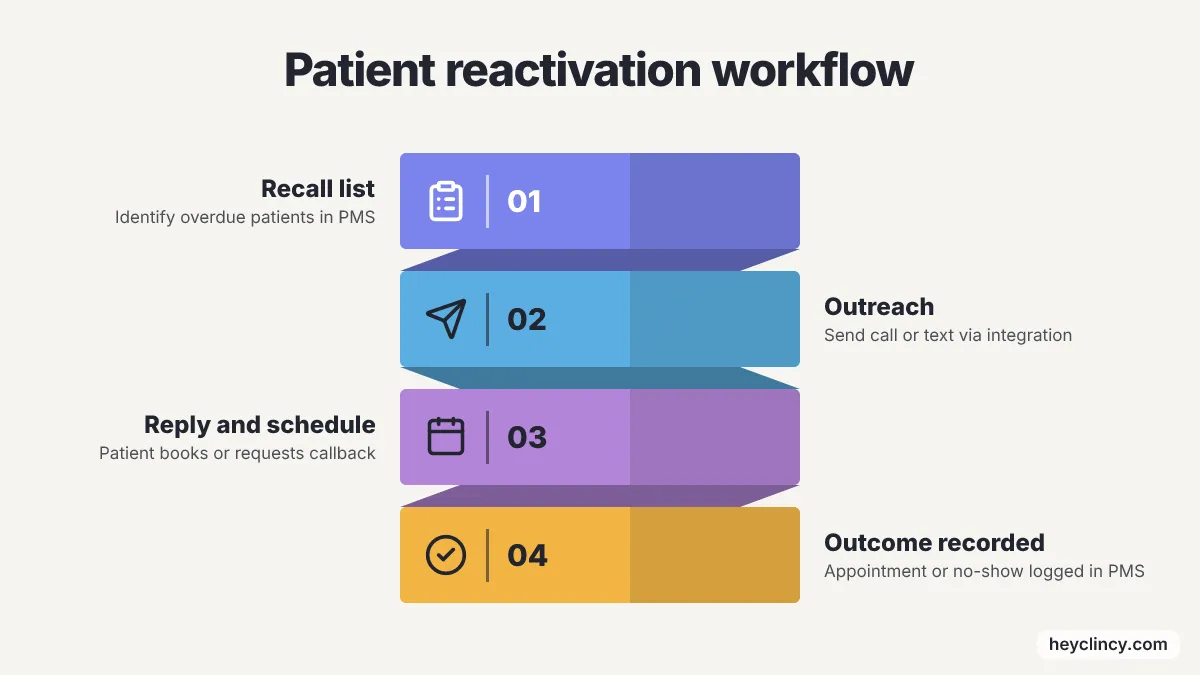
Start with one workflow, not the vendor demo. A practice that wants to reactivate overdue patients should ask each vendor to show exactly how a patient moves from the recall list to outreach, reply, scheduling attempt, confirmed appointment, and outcome recorded in the PMS.
Open Dental practices should treat API change tracking as part of vendor diligence. Open Dental said in August 2026 that Version 26.2 beta release notes added new API capabilities, a new Allied Star Connect bridge, and HQ global alerts in the title bar, so an integration vendor should be able to say how it monitors new and changed endpoints before building against them.
Open Dental Version 26.1 matters for vendors touching insurance or claims-adjacent workflows. Open Dental said in August 2026 that Version 26.1 stable release overhauled the Edit Insurance Plan window, added Code Groups to Insurance History, and improved EDS clearinghouse claim validation, so eligibility, treatment presentation, and billing-adjacent integrations need more scrutiny than a basic recall text tool.
Dental software cost belongs in the integration decision because add-on tools rarely replace the PMS bill. Open Dental said in February 2026 that its software license and support fee increased to $199/month for new signups, while offices that started at $179 before February 2, 2026 keep that rate for the entire initial 12 month period, so a new practice should compare the full stack cost before adding a reactivation platform.
The exception is a Canadian office or teaching-clinic environment using Open Dental modules affected by Version 25.4. Open Dental said in April 2026 that Version 25.4 release notes included PaySuite integration for Canada and a Dental Schools overhaul, so those practices should test payment and school workflows before judging a vendor by recall automation alone.
Clincy is building AI calls and texts for dental patient reactivation and unscheduled treatment follow-up, with Open Dental as its initial pilot focus. Open Dental teams comparing integration depth can continue with the Open Dental reactivation walkthrough when the buying question shifts from platform coverage to the patient callback and handoff workflow.
Front desk acceptance depends on what happens after the patient replies. A PMS integration should make the next owner obvious, because a callback about a crown estimate belongs with a treatment coordinator, while a hygiene recall reply belongs with the scheduling person who can see appropriate openings.
Use a short test before signing a long contract:
- Confirm which Open Dental fields the tool reads, writes, or leaves untouched.
- Ask how opt-outs, wrong numbers, and contact preferences are stored.
- Run one overdue patient segment and one unscheduled treatment segment separately.
- Assign a named owner for replies before the first message goes out.
- Check whether completed visits, not just sent messages, appear in reporting.
Before testing any AI call or text workflow, write the approved wording for overdue hygiene, incomplete treatment, and patients who ask for cost before scheduling. A practice that needs a starting point can adapt these Clincy patient reactivation scripts before loading a small test list.
Patient data quality decides whether any PMS integration behaves safely. If the recall list contains inactive patients, stale mobile numbers, missing preferences, or duplicate family records, clean the fields first with a practical patient data management for AI process before letting automation contact patients.
Staff capacity still sets the ceiling for every tool in this list. A practice short on hygiene coverage or front desk ownership should fix the handoff plan before increasing outreach volume, and teams with a staffing problem may need to address dental hiring through a focused resource such as long-term hygienist hiring strategies before filling more schedule openings.
Next step: test one recall workflow in your PMS
Start with a small reactivation test inside the PMS your team already uses. Pick one overdue segment, one unscheduled treatment segment, one reply owner, and one reporting measure tied to completed visits, then ask each integration vendor to prove that exact workflow rather than presenting a general platform tour.
A shortlist cannot replace a security review, a data cleanup, or a front desk handoff plan. The right next step is a live workflow test using real field names, real appointment types, and a small patient list your team is willing to monitor every day until the outcomes are recorded correctly.
Frequently Asked Questions
What is the best dental PMS integration for recall work?
The best dental PMS integration for recall work depends on the specific needs of the practice. Pearly is ideal for broad PMS coverage, CRMBridge.ai offers unified API integration, and TensorLinks connects with major platforms. Each has its strengths based on the practice's workflow and system requirements.
How does Pearly support dental practices with multiple PMS systems?
Pearly connects with over 80 dental practice management systems, including Dentrix, Open Dental, and Eaglesoft. This broad coverage allows practices or small groups to maintain consistent follow-up logic across different locations without needing to rebuild workflows for each PMS.
What makes CRMBridge.ai suitable for practice groups?
CRMBridge.ai is suitable for practice groups because it provides a unified practice management integration API that connects with multiple systems, including Dentrix, Eaglesoft, and Open Dental. This broad API coverage reduces the cost of changing front-end tools and supports integration across various practice management systems.
Why would a practice choose TensorLinks for PMS integration?
A practice might choose TensorLinks for its strong connectivity with major dental PMS platforms like Dentrix, Eaglesoft, and Open Dental. TensorLinks is suitable for practices that prioritize integration infrastructure for scheduling and patient communication across established PMS environments.
How does Dentin.ai enhance front desk workflows?
Dentin.ai enhances front desk workflows by integrating AI receptionist capabilities with PMS data. Dentin.ai automates scheduling, reduces cancellations, and improves patient communication, making it suitable for practices that want the integration to be visible at the front desk, especially for scheduling and patient communication tasks.
Related reading
- Effective Patient Data Management for AI Integration
- Top 6 Strategies for Hiring Dental Hygienists Long-Term
- Agency vs. Direct Dental Hygienist Hiring: Which Costs More?
- 6 Best Dental Recall Services for Small Texas Practices
Sources
Clincy keeps treatment conversations moving with personalized texts, human support, and scheduling in your practice management system.
Book CallMore from the blog
6 Services to Reactivate Dental Patients in the USA
Explore six dental patient reactivation services focusing on PMS integration, channel mix, and monthly cost. Learn three checks to avoid a bad fit.
6 Best Dental Reactivation Scripts for Front Desk Staff
Compare six script sources for reactivation calls, recall texts and front desk training, with checks for Open Dental handoffs and patient replies.