Top 6 Texting Tools for Dental Offices: Ranked by Recall
Compare 6 dental texting tools on Open Dental sync, workflows, and cost. Learn how to improve retention and manage patient replies effectively.
Summary: Dental offices seeking effective texting tools should prioritize platforms that convert patient replies into confirmed appointments and integrate outcomes into their practice management systems. Clincy excels in patient reactivation and unscheduled treatment follow-up, while Weave offers comprehensive communication features. Falkon SMS provides affordable two-way texting, and Solutionreach and Lighthouse 360 cater to larger practices with broad engagement needs. AI recall specialists like TensorLinks and Savvy Agents enhance recall completion rates. Disclosure: Clincy publishes this guide and is included in the ranking.
The morning huddle wraps up, the waiting room starts to fill, and your front desk coordinator is already bouncing between phone lines, patient check-ins, and a spreadsheet of overdue hygiene recalls. Adopting dedicated texting for dental offices often begins with the promise that batch text blasts will handle those outreach calls. But automated notifications that arrive without a way to handle replies just push the bottleneck to the front counter.
A patient texts back to ask whether a new insurance plan covers bitewings, and standard broadcast software leaves the exchange hanging. Generic blasts can notify patients, but they do not confirm chair time, answer basic scheduling questions, or write completed appointments back into practice management software. Research published by the Journal of the American Dental Association points to the size of dormant records, showing that the average practice keeps only 41% of patients after the first visit, per Operaitor's reactivation research.
Most dormant patients still answer on their phones. Turning those records into scheduled production takes two-way dialogue, not outbound blasts. For independent dental practices managing one to ten locations on Open Dental, the main requirement is not the lowest monthly software fee. The platform has to turn inbound replies into booked chair time and send the visit details back to the clinical chart.
1. Clincy: AI reactivation and treatment follow-up for Open Dental
Clincy is built around automated voice outreach and two-way messaging for dental patient reactivation and unscheduled treatment follow-up, with its first integration pilot built directly for Open Dental. It is not a broad clinic communication platform. The software reads inactive patient files and outstanding treatment plans, carries on natural conversations when patients ask questions, and places booked appointments straight into the practice schedule.
Targeting diagnosed, uncompleted treatment along with regular hygiene recall brings in far more production than standard hygiene prompts alone. A 30-day evaluation at a single-location general practice found that an autonomous recall system integrated with Open Dental identified 836 qualifying patients representing $2,544,990 in total treatment value, with most of that production tied to unscheduled treatment plans rather than routine cleanings, according to Operaitor's case study. Platforms that stop at six-month prophy notifications miss the highest-value procedures already sitting in patient charts.
Front desk teams running Open Dental get a dedicated system where incoming replies receive immediate responses without creating another unmonitored inbox. Practices using Dentrix or Eaglesoft should keep the platform on their radar while pilot testing continues on Open Dental ahead of broader PMS support. Dental teams can start refining their manual messaging protocols right away with the Clincy dental patient reactivation scripts while they sort through software options.
2. Weave: all-in-one phone and texting suite
Weave offers a broad communication suite that brings together two-way text messaging, VoIP telephony, digital intake forms, online appointment booking, text-to-pay billing, and online review requests in one system. The platform keeps native write-back connections to Open Dental, Eaglesoft, Dentrix, and more than 20 additional practice management systems. Procedure-code-aware automation lets the software tell six-month hygiene recalls from annual periodontal maintenance exams, so outgoing messages can follow the clinical codes recorded in the chart.
Putting every office communication tool under one vendor creates noticeable overhead and technical demands. Subscription pricing starts at $249 per month across three tiers, and getting the full feature set means taking Weave as the office VoIP carrier along with an upfront $750 setup charge, as PracticeSignal's 2026 comparison details. Practice managers report occasional synchronization delays during heavy morning traffic, while entry-level subscriptions cap broadcast messaging at 1,500 outgoing texts each month.
Offices that want to replace aging phone hardware get the most from Weave, which routes incoming calls, patient texts, and missed-call responses into one desktop interface. Practices that are happy with their current telephone setup end up paying for phone services and hardware they do not need just to get two-way SMS capabilities.
3. Falkon SMS: low-cost texting on your landline number
Falkon SMS adds texting to an office's current landline number, so patients can text the same number they already call. It includes HIPAA and SOC 2 compliance, shared inbox views for the team, scheduled messages, and unlimited one-to-one messaging. Pricing starts at $14.99 per user each month on an annual Essential agreement, or $24.99 per user monthly for the HIPAA Pro tier with an executed Business Associate Agreement. A three-person front desk team can get compliant texting for about $75 a month, while full-service platforms begin at $249.
The clear limit at this entry level is direct sync with clinical databases. The platform has no native sync for Open Dental, Dentrix, or Eaglesoft, and it depends on third-party Zapier links instead. It also leaves out native online scheduling tools and reputation management screens, as Falkon's dental platform overview says. That is where light messaging tools stop and clinical automation starts. Practices that want the lowest monthly price for landline texting will find Falkon workable, and they will not need advanced AI reactivation tools. Offices that need to reopen overdue charts and write confirmed slots back into Open Dental will find connector bridges too thin for dependable day-to-day front desk work.
Independent offices that want a simple, compliant two-way messaging portal without changing their current tech setup get a dependable communication line, as long as staff still handle recall lists and scheduling by hand inside the practice management software.
4. Solutionreach: patient engagement for multi-provider groups
Solutionreach is one of the longest-running patient engagement providers in healthcare, with links to more than 500 clinical systems, including Open Dental, Eaglesoft, Dentrix, and Curve Dental. The company prices its service in three main tiers: Core at $299 per month, Plus at $449 per month with online booking and review tools added, and Premium at $599 per month, per Softwr's November 2026 pricing check. The Core package includes automated appointment reminders, two-way texting, basic recall sequences, and a secure patient web portal.
Long contract terms create friction for growing offices. The vendor uses standard annual agreements that renew automatically, while PracticeSignal's comparison points to aggressive contract practices and billing complaints that make it hard to recommend even with the features in place. Data sync also varies by practice management system, so teams need to verify two-way Open Dental write-backs before they sign.
Multi-provider groups and larger dental organizations that want one platform for outreach across different software setups fit the Solutionreach operating model. Single-location practices trying reactivation messaging for the first time face less financial risk with month-to-month alternatives that leave more room to walk away if the fit is wrong.
5. Lighthouse 360: dental-only reminders and recall
Lighthouse 360, maintained by Henry Schein One, focuses only on dental practices. It offers automated visit reminders, two-way texting, recall tracking, and automated patient reviews at a published rate of about $329 per month, per Intake Dental's 2026 buyer's guide. The software connects with more than 30 dental management systems, including Open Dental and Curve Dental, and it includes an automated cancellation fill-in module that alerts waitlisted patients when schedule gaps open up.
The software works mainly as a structured notification tool, not as an independent scheduling assistant. Outgoing recall sequences run on fixed triggers, so any patient reply that asks about scheduling goes into an administrative queue for the front desk to handle. Busy practices have to count the staff time needed to manage those inbound threads by hand when they look at the total software cost.
Established dental practices that want dedicated dental software with clear monthly pricing and no telephone migration requirement will find Lighthouse 360 a steady option, if their administrative staff has enough daily time to answer patient questions manually.
6. AI recall specialists: TensorLinks, Savvy Agents and Revado
Autonomous recall platforms represent a specialized category engineered to convert dormant patient files into confirmed schedule seats through multi-step outreach across phone, text, and email. TensorLinks reports an improvement in recall completion by using automated outreach sequences over several contact attempts, booking confirmed appointments directly into Open Dental. Savvy Agents operates an autonomous assistant named Novi that scans Open Dental recall rosters and successfully converts overdue patient files into appointments within its reporting dashboard. Revado deploys coordinated cadences combining text messaging and conversational voice agents that evaluate real-time operatory openings during calls, categorizing each patient record as reached, scheduled, declined, or unreachable.
Performance records from clinical pilot evaluations show measurable gains over traditional blast reminders. In the 30-day Operaitor clinical trial, an outreach cohort of 412 approved patient records generated a 41% overall response rate and produced 72 self-scheduled appointments, contrasting with typical industry response rates of 8% to 12% for routine dental recall messages, while conversational messaging salvaged 42 appointments from patients who failed to respond to basic single-prompt reminders, per the case study.
Supporting data from a Peerlogic analysis covering several dental clinics indicated that automated patient reactivation recaptured significant production per location within a single month.
Practices maintaining an inactive database of more than 500 patients without available front desk hours for outbound phone calls achieve the highest return from these specialized systems. Because these automation vendors represent newer market entries with shorter operating histories than legacy vendors, running an initial 30-day trial with a single patient group provides a sensible validation step before full deployment.
How to compare them: the four checks that decide it
| Platform | Open Dental sync | Base monthly price | Recall delivery model | Agreement type |
|---|---|---|---|---|
| Clincy | Native write-back (pilot) | Pilot pricing | AI reactivation and treatment follow-up | Pilot agreement |
| Weave | Native write-back | $249/mo plus $750 setup | Procedure-code-aware reminders | Month-to-month |
| Falkon SMS | Zapier connection only | $14.99 per user/mo | Scheduled outgoing reminders | Month-to-month |
| Solutionreach | Native sync (depth varies) | $299/mo | Automated recall sequences | Annual auto-renewing |
| Lighthouse 360 | Native sync (30+ PMS) | ~$329/mo | Scheduled reminder workflows | Monthly subscription |
| AI recall specialists | Native write-back | Varies by provider | Autonomous multi-touch cadence | Varies by provider |
Practice leaders can evaluate each prospective messaging system against four operational standards before entering a contract.
Practice management database synchronization: confirm whether schedule updates made inside Open Dental reflect inside the messaging software instantly, and verify that appointments booked by the texting tool write back with the correct provider and procedure code. Partial one-way synchronization frequently leads to double bookings and duplicate reminder notifications sent to patients who already rescheduled.
Regulatory and messaging consent standards: guidance from the American Dental Association specifies that healthcare providers may transmit treatment-related text communications without prior written authorization, provided messages remain strictly focused on patient care, stay within 160 characters, state the practice identity clearly, and adhere to limits of one text per day and three texts per week, per the American Dental Association's phoning rules. Including promotional pricing, cleaning specials, or whitening offers instantly reclassifies an outbound text as commercial marketing under Telephone Consumer Protection Act regulations, requiring documented prior express written consent and risking statutory damages ranging from $500 to $1,500 for each unauthorized message, per Dentalbase's 2026 reactivation guide. Ask prospective software vendors how their default message templates separate clinical recall prompts from regulated marketing text.
Inbound conversation ownership: determine the exact staff workflow when a patient sends a detailed insurance question late in the afternoon, confirming whether the software provides automated conversational answers or leaves the notification in a queue.
True first-year operational investment: calculate the comprehensive cost of ownership including onboarding charges, phone equipment purchases, add-on features, and platform user fees rather than evaluating base subscription stickers alone.
What a reactivation text workflow actually looks like
Deploying texting software produces reliable scheduling outcomes only when backed by a structured administrative process. A durable reactivation workflow incorporates five operational stages.
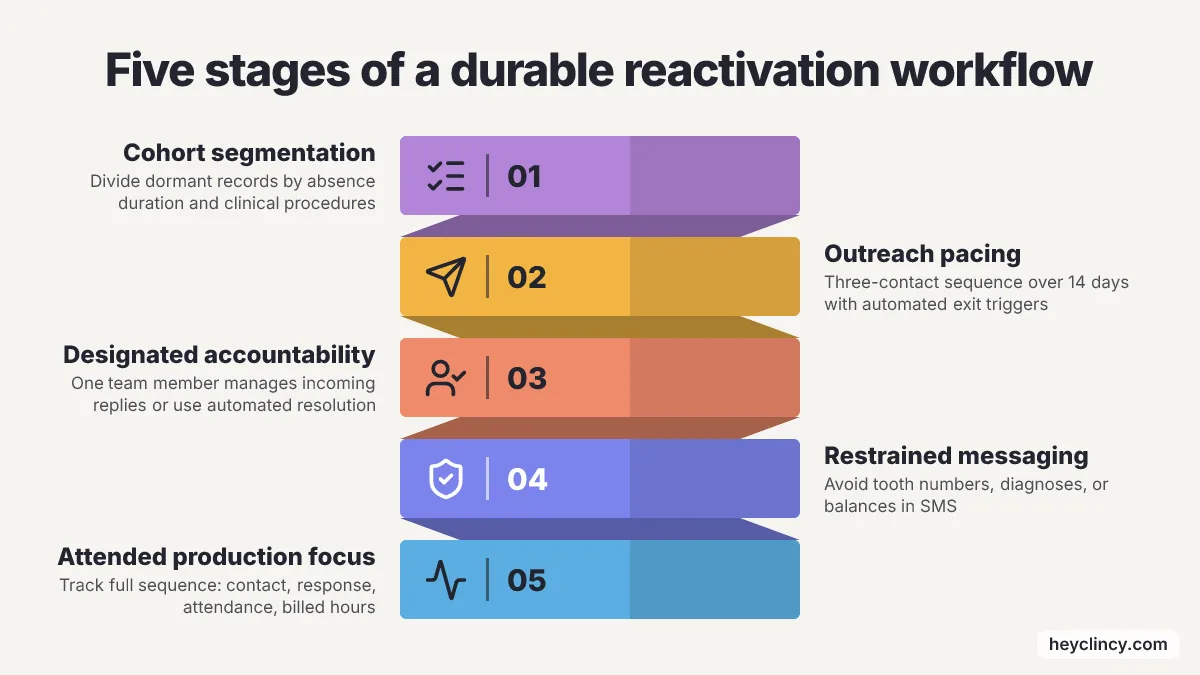
Cohort segmentation prior to sending: divide dormant records by the duration of absence and the specific clinical procedures recommended. A patient overdue four months for a prophy requires an entirely different conversation than a patient who left a crown prep unscheduled, a distinction reinforced by the Operaitor evaluation where unscheduled treatment accounted for $2,430,140 of the total $2,544,990 clinical opportunity identified, compared to $37,950 tied to routine cleanings, per the case study.
Outreach pacing with automated exit triggers: establish a defined contact sequence, beginning with an introductory text, continuing with a follow-up inquiry five days later, and concluding with a third check-in at ten days, removing the patient from the outreach sequence the moment an appointment is reserved. Revado structures its sequences around three to four automated text and voice contacts over a 14-day window, dropping engaged contacts from the queue immediately upon response.
Designated accountability for incoming replies: unattended inbox queues undermine patient trust and waste outbound outreach investments. Designate one administrative team member to manage incoming questions, or deploy software that resolves standard scheduling questions automatically while escalating complex clinical inquiries to office staff.
Restrained message composition: avoid detailing specific tooth numbers, pending clinical diagnoses, or ledger balances inside standard SMS exchanges, protecting patient privacy under federal minimum-necessary standards.
Focus on attended chair production: booking an appointment does not produce revenue if the patient fails to show up. Monitor the complete sequence from initial contact to response rate, reserved appointments, attended visits, and billed production per completed operatory hour.
Where the cheaper option is the right one
Clinics managing smaller patient rosters do not always require automated intelligence layers, and purchasing advanced automation prematurely creates unnecessary software expenses. When a practice carries fewer than 200 overdue hygiene records and an administrative coordinator reserves an hour each morning for outbound follow-up, straightforward reminder software like Lighthouse 360 or Open Dental's native recall engine paired with direct staff phone calls handles the roster efficiently. Preserving personal staff contact also gives the practice complete control over conversation tone, which helps when reconnecting with long-absent patients who may have encountered billing or clinical concerns during prior visits.
This manual strategy reaches its limit as dormant patient counts expand into the hundreds and outstanding treatment plans accumulate across the database. When an administrative team no longer has the desk hours required to call overdue charts, basic text reminders fail to convert most dormant accounts. That specific operational bottleneck marks the threshold where investing in an automated reactivation platform pays for itself through filled operatory chairs. Even so, initial 30-day pilot response rates do not always forecast full-year conversion consistency, because early trial cohorts typically consist of the most receptive patients in the practice database.
Conclusion: how to choose a dental texting tool
Export your Open Dental recall report alongside your outstanding treatment tracker to review the exact count of unassigned patients and the total fee value of unscheduled care. If your inactive roster contains fewer than 200 charts and an administrative team member can dedicate an hour each morning to outbound calls, maintain personal outreach and pair it with entry-level reminder tools. When your dormant list exceeds 500 files or holds thousands of dollars in uncompleted treatment plans, initiate a 30-day pilot using an automated reactivation platform on an initial patient group to track completed operatory visits rather than raw booking numbers. Your internal clinical numbers provide the direction needed to choose the right communication system. Practices establishing their manual or automated messaging workflows can use our dental office text messaging templates to implement proven patient recall sequences immediately.
Frequently Asked Questions
What is the best texting tool for reactivating dental patients?
Clincy is built specifically for reactivating dental patients. It specializes in automated voice outreach and two-way messaging for patient reactivation and unscheduled treatment follow-up, integrating directly with Open Dental to book appointments and update practice schedules.
Which texting tool offers the most comprehensive communication features for dental offices?
Weave offers the most comprehensive communication features, combining two-way text messaging, VoIP telephony, digital intake forms, online appointment booking, text-to-pay billing, and online review requests in one system. It integrates with over 20 practice management systems.
What is the most affordable texting tool for dental offices?
Falkon SMS is the most affordable option, starting at $14.99 per user per month on an annual plan. It allows texting from the office's current landline number and includes HIPAA compliance, but lacks native integration with practice management systems.
Which texting tool is best for large dental practices with multiple providers?
Solutionreach is well-suited for large dental practices with multiple providers. It offers extensive links to over 500 clinical systems and provides a range of patient engagement features, although it requires long-term contracts and has varying data sync capabilities.
What are the limitations of using Lighthouse 360 for dental office texting?
Lighthouse 360 primarily functions as a structured notification tool, not an independent scheduling assistant. It requires administrative staff to manually handle patient replies related to scheduling, which can be time-consuming for busy practices.
Recommended resource
Related reading
- Effective Dental Office Text Messaging Templates
- Top Dental Clinic Review Platforms in the United States
- Top 6 Arizona Dental Clinics by Care Specialty and City
- 2 Best Dental Appointment Recall Tools to Compare
Sources
- Best Texting Platform for Dental Offices
- Weave vs NexHealth vs Solutionreach: Which Dental Communication Tool Is Right for Your Practice? (2026): PracticeSignal
- Solutionreach Pricing: Every Plan Compared (2026) - Softwr
- Patient Reactivation Campaigns for Dental Practices | Operaitor
- Impact of Autonomous Recall on Chair Utilization | Operaitor
- Follow the Rules When Phoning Patients | American Dental Association
Where to go next
Clincy keeps treatment conversations moving with personalized texts, human support, and scheduling in your practice management system.
Book CallMore from the blog
Text Messaging for Dentists: 6 Recall Tools Compared
Compare top dental texting tools for recall efficiency, focusing on chart context, patient history, and real-time replies. Check SMS fees and TCPA updates.
Top 6 Dental Online Intake Form Solutions Compared
Compare 6 dental intake form tools: FormDr, Yapi, mConsent, iDentalSoft, CERTIFY Health and PracticeDilly, by PMS fit, patient handoff and front-desk work.