Implementing AI Imaging in Dental Practices: A Strategy Guide
Learn how ai imaging tools for dental practices can reduce insurance denials, boost case acceptance, and improve clinical and front-office efficiency.
Updated
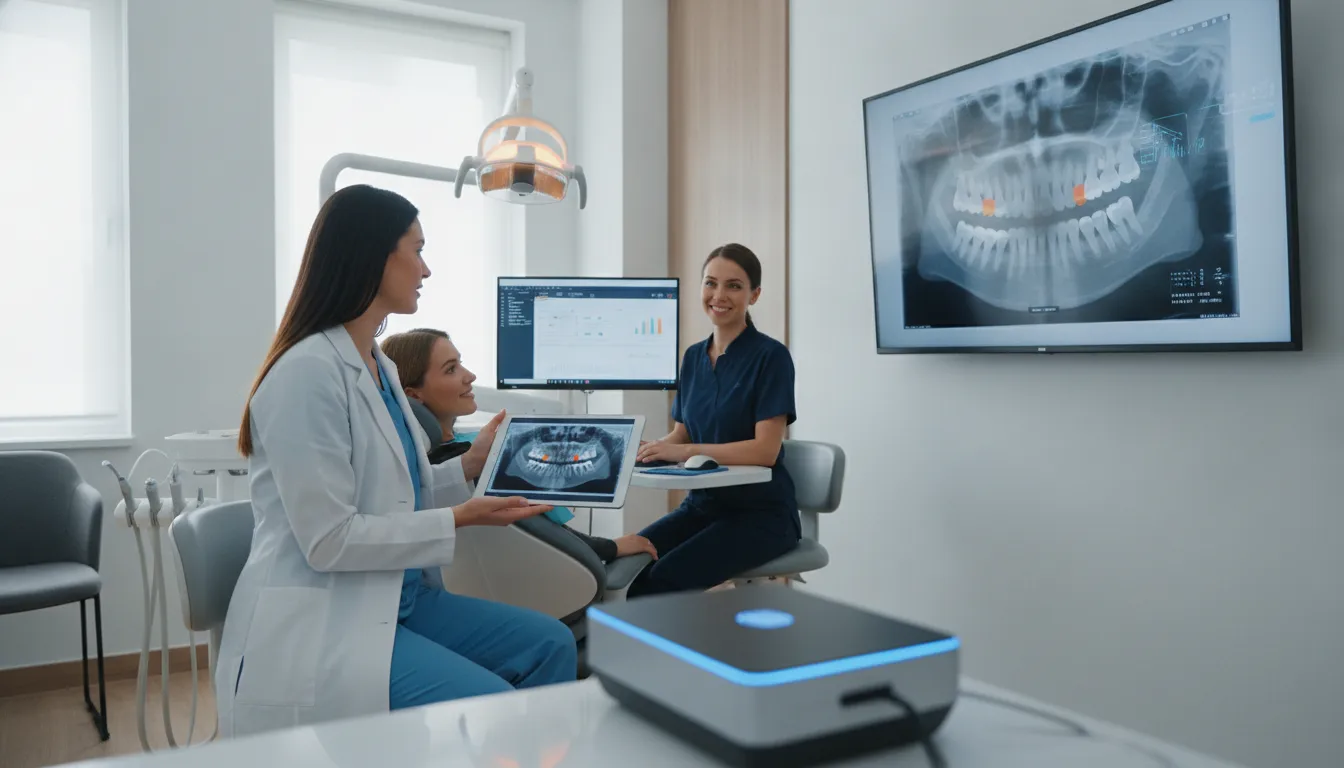
Summary: AI imaging tools in dental practices address the issue of poor image quality, which leads to insurance claim denials and the need for retakes. These tools enhance image quality at capture, reduce errors, and improve pathology detection. They also increase patient treatment plan acceptance by 10 to 25 percent by providing clear, AI-highlighted evidence, leading to better documentation, less waste, and more effective patient communication.
Dental practices are running into a very specific problem. Up to 20 percent of insurance claims get denied because the images are poor. That means more re-takes, more resubmissions, and more time spent fixing work that should have been done once. AI imaging tools are a practical answer here, not a moonshot. They can check image quality at capture, catch errors before the patient leaves, and help clinicians spot pathology more consistently. Research also suggests treatment plan acceptance can rise by 10 to 25 percent when patients see objective, AI-highlighted evidence of what’s going on. For owners, the appeal is plain. Less waste. Better documentation. Stronger patient conversations.
Key Takeaways
- Hard production gains: Dental practices using advanced AI imaging often report an average annual net production increase of 13% for restorative and periodontal treatments.
- Immediate insurance relief: Up to 20% of insurance claims are denied at first because the images are low quality, and real-time AI checks can cut that down.
- Boosted case acceptance: Patients are 10 to 25% percent more likely to accept treatment plans when they can see clear, AI-annotated images of their own findings.
- High ROI potential: Some providers report returns on investment above 400%, helped by better diagnostic capture and less manual rework.
- Strategic staff support: Tools like Clinads take routine imaging checks and communication chores off the team’s plate.
How can AI imaging improve my dental practice’s bottom line?
It starts with better detection. AI imaging can find 30 to 40 percent more pathology on radiographs, which creates more chances to identify restorative and periodontal needs that might have slipped by. That means more useful findings, and more production tied to real clinical work.
The admin side matters too. If the system catches a bad X-ray right away, the office avoids recalls and spends less time fighting claim denials. Staff stop chasing the same problems all day. They can spend more time on utilizing third-party services for dental insurance claims, which helps the office run with less manual processing and better margins. You can check this with our Open Dental setup guide.
What is the difference between diagnostic AI and quality verification?
They do different jobs. Diagnostic AI looks for disease. Quality verification checks whether the image itself is usable.
Systems like VideaHealth, Pearl, and Overjet scan radiographs for caries, bone loss, or lesions. They give the clinician a second set of eyes and help with treatment planning and patient education. The focus is on what appears in the image.
Quality verification tools work earlier in the chain. They judge whether the X-ray is clear, properly aligned, and complete enough for diagnosis, often with a quality score attached. They do not diagnose disease. They make sure the image is fit to use before the patient gets up from the chair.
Many practices use both. One helps spot problems. The other keeps bad images from entering the workflow in the first place. You can find more on managing these workflows in our 6 Best Patient Communication Automation Tools for 2026.
Can AI help reduce front-desk administrative burden?
Yes. It can.
AI cuts front-desk admin load by taking over work that eats hours, like insurance checks, appointment booking, and patient messages. Beyond imaging, AI systems can answer inbound calls, keep recall lists moving, and handle two-way chat, which gives staff back a noticeable chunk of the week. Once those routine exchanges are off the desk, people stop living inside spreadsheets and schedule changes.
That matters because front-desk teams can spend more time on the ethical practices in clinic operations: a guide for clinic owners and patients that keep patients coming back. Practices that use AI for imaging and office communication, including tools from Clinads, tend to get a cleaner day-to-day workflow. You can compare those automations with our practice efficiency audit. The payoff is less dependence on manual labor, which helps when hiring is tight and the service standard still has to stay high.
Is AI imaging difficult to integrate into existing practice management?
Usually, no.
Most major AI imaging tools are built to sit inside common practice management software, including Open Dental. That used to be the hard part. Separate systems slowed everything down, but newer tools send findings straight into the clinical record, so dentists can review annotations during their normal workflow. The strongest rollouts start with a few clear targets, like case acceptance or diagnostic capture, before anyone calls the pilot a success.
If you're planning a move, pick tools that plug in cleanly and give clinicians a result they can actually trust. You can check readiness with our digital workflow calculator. Skip that step and you often end up juggling duplicate systems. People hate that. The software starts feeling like extra work, and then it gets ignored.
How do I measure the ROI of my AI imaging investment?
Split the numbers.
Clinical AI and administrative savings belong in different buckets. For the clinical side, track treatment plan acceptance, the share of AI-flagged pathology that turns into confirmed treatment, and overall restorative production. Those figures show whether the software is finding value during exams.
On the admin side, watch claim denials tied to image quality and the hours lost to manual verification. Before rollout, run a 30-day baseline. Then measure 60 days with the system live. That gives you something solid to show partners or stakeholders. Make sure your practice management software is logging the results correctly, because guessed numbers make bad ROI stories.
How can AI improve patient experience in dental practices?
Clearer pictures help.
AI can show annotated visuals that make dental problems easier to understand, and that usually builds trust. When patients see AI-marked issues on their X-rays, the treatment conversation gets less vague. They ask better questions. They also decide with more confidence.
It can help outside the operatory too. Scheduling and reminders move faster, wait times shrink, and front-desk staff have more room to treat each patient like a person instead of a slot on the calendar. That tends to improve satisfaction, and happy patients talk.
How does AI support dental staff training and development?
By giving people feedback they can use.
AI tools can flag weak image quality, which helps staff see what needs fixing and practice until it improves. The loop is simple, and that simplicity matters. Instead of waiting for a rare off-site course, staff get feedback in the middle of ordinary work. AI can also simulate different clinical situations, so people can practice diagnostic judgment without pressure. That steady exposure builds competence, and confidence usually follows.
Conclusion
AI imaging tools make sense for dental offices. They take pressure off the front desk, and they can tighten diagnostic work at the same time. Image review can cut denials and callbacks, which gives staff fewer forms and more time with patients. On the diagnostic side, the software can flag issues on X-rays, and that often makes treatment feel more tangible to patients. If you run one office or several, Clinads and similar tools can help the team stay more consistent. Start with your baseline KPIs. Pick software that fits the systems you already use. Offices that move now are building something steadier, easier to manage, and more profitable.
Frequently Asked Questions
Does AI imaging replace the dentist in the diagnostic process?
No. The dentist still decides. AI acts like a second set of eyes, spotting possible pathology such as caries or bone loss on radiographs, while the licensed clinician makes the final call, sets the treatment plan, and explains it to the patient.
Are AI-annotated images enough to prevent insurance claim denials?
They can cut denials tied to image quality, but they won't solve every claim issue. Clear images matter. Documentation matters too. Coding does, too. AI gives you a cleaner starting point for the claim, and human review still has to catch the rest.
What is the typical timeline to see a return on investment with AI?
Many practices say the tools pay for themselves within three months. That depends on the starting point and on how well the team uses them. Early gains often show up sooner than people expect, sometimes within the first 90 days of steady use.
How do I ensure my staff will actually use the new AI tools?
Training matters. So does choosing tools that sit naturally inside software your staff already knows, like Open Dental. Don't create another screen where people type the same data twice. If the AI surfaces findings inside the workflow they already use, people are much more likely to keep using it.
Should I pilot AI tools in one location before scaling?
Yes. That makes sense, especially for multi-location practices. A 30-day baseline period followed by 60 days of live use gives you practice-specific data you can defend. It also helps you catch integration problems, train the core team, and check ROI before a wider rollout.
Related reading
- Utilizing Third-Party Services for Dental Insurance Claims
- Challenges in Insurance Verification for Dental Practices
- Ethical Practices in Clinic Operations: A Guide for Clinic Owners and Patients
Sources
- Whitepaper: Dental AI Hype or Reality
- AI ROI Guide for Dental Service Organizations
- Real-time dental image verification with Amazon SageMaker AI at Henry Schein One - HKU SPACE AI Hub
- Real-time dental image verification with Amazon SageMaker AI at Henry Schein One | Artificial Intelligence
- Dental AI: The Complete Guide for Practices | Denti.AI
- Analyzing the Financial Benefits of Implementing AI Technologies in Dental Practices and Their ROI | Simbo AI - Blogs
- Is AI Charting and Imaging Actually Paying for Itself? A Dental Practice ROI Framework | Techvera Blog | Techvera
- How Dental Practices Use AI in 2026: A Practical Guide
- The Impact of Digital Imaging Tools and Artificial Intelligence on Self-Reported Outcomes of Dentists
- Recent dental practices using Artificial Intelligence (AI): A survey
- Pediatric Urgent Care in Anaheim | Walk-In Clinic
- Florida Atlantic Medical Group - Primary Care
- Optum Ear, Nose and Throat (Otolaryngology) - Glen Cove, NY
- Weight Loss Center in St. Augustine | Crescent Beach Care
- Plattsburgh Family Health: Quality Primary Care...
- Cancer Institute
- Mount Carmel Heart & Vascular Specialists Hilliard
- Christopher Y. Maeda, MD | Bothell, WA - Providence
- Heart Center Doctors in Bradenton | HCA Florida Blake Hospital
- Find occupational health in Midland, MI
- Clinads
- Overjet AI or Pearl AI (Dental AI Imaging) -- Any Real Use? - Reddit.
Clincy completes new-patient intake by voice or SMS before the visit, then writes it back to your PMS.
Book CallMore from the blog
Effective Staffing Solutions for Dental Practices
Explore effective staffing solutions for dental practices to enhance patient intake and operational efficiency.
Utilizing Third-Party Services for Dental Insurance Claims
Discover how to modernize your dental practice with automated intake tools like heyintake to reduce administrative burnout and streamline patient onboarding.