6 Best Dental Reactivation Scripts for Front Desk Staff
Compare six script sources for reactivation calls, recall texts and front desk training, with checks for Open Dental handoffs and patient replies.
Summary: The best dental patient reactivation scripts for front desk staff are those tailored to specific patient segments, booking goals, and reply ownership. Effective scripts address overdue hygiene, unscheduled treatments, missed calls, and objections to cost or timing. Practices should choose scripts based on their needs for custom language, staff training, script libraries, or improved handoffs from calls and texts to confirmed appointments.
A patient calls back while check-in lines start to spill past the reception counter, and the recall tracker inside Open Dental still shows untouched contact lists from two days ago. The hygiene coordinator has an unexpected two o'clock opening, the treatment coordinator needs an estimate confirmed for a major restorative case, and nobody at the front desk knows whether a reminder text went out that morning.
Finding the best dental patient reactivation scripts for front desk staff means going past polite phrasing that leaves staff stranded the second a patient answers.
A script falls flat when it only tries to sound friendly and gives no clear route to a firm date on the schedule. Practical language ties directly to a defined patient group, an immediate booking target, an assigned staff owner, and an updated status note in practice management software. Front desk teams run into trouble when they lean on one generic script for overdue prophylaxis, incomplete treatment plans, missed incoming calls, last-minute cancellations, and patients who raise fee objections. The right script source depends on whether your practice needs custom messaging, structured phone training, a reference script library, or an organized handoff between outreach and chairside scheduling.
1. KickStart Dental Marketing: segmented reactivation campaigns
KickStart Dental Marketing reactivation fits practices that want scripts broken out by clinical category instead of sending one broad message to every inactive account. KickStart says its front desk coaching focuses on turning dormant contacts into booked chair time, with scripts written for SMS, email, and automated voice outreach across distinct patient groups.
Audience segmentation changes the shape of the conversation. Someone overdue for a six-month cleaning needs a different approach than a patient who left without scheduling a multi-unit bridge. A hygiene outreach call removes friction around choosing a calendar slot: Jordan, this is Maya from your dental office calling because your routine cleaning is due this month, and our hygiene schedule fills quickly. Would you prefer a morning visit or an afternoon time later this week?
Restorative treatment calls focus on the clinical concern the doctor identified and move quickly into a financial coordinator consultation.
This approach works for dental offices ready to organize contact lists before they pick up the phone.
The operational trade-off sits in the preparation. Your office manager has to build patient lists, approve scripts, and decide whether clinical or administrative staff respond to inbound replies before the first outreach batch goes out.
2. Patient Excel: full front desk conversion training
Patient Excel front desk training is built for practices that need reactivation conversations folded into an end-to-end telephone process. Patient Excel says its operational training covers the whole conversion path, combining outbound recall dialogues, schedule reactivation, and missed call recovery into one front desk workflow.
Thorough training keeps reactivation callbacks from colliding with urgent new patient calls and daily arrival check-ins. A front desk team gets stuck when one staff member spends hours dialing overdue patients while another lets inbound calls roll to voicemail because nobody assigned coverage priorities. The main benefit of this training comes from clear protocols for answering, screening, scheduling, and charting every phone call without creating overlapping follow-up tasks.
Effective phone training puts objection responses inside the appointment booking flow instead of treating pushback as a separate issue.
When a patient says they need to check personal calendars before choosing a time, staff keep the scheduling momentum with a clear option: I can reserve a tentative slot on Thursday morning while you check your calendar, and if that time conflicts with your day, I will text two alternate afternoon slots before noon. Patient Excel matters most when leadership wants to improve overall phone habits rather than just hand staff a sheet of script ideas.
3. BoomCloud: cancellation prevention and wellness reminders
BoomCloud front desk scripts gives front desk teams exact wording they can use so booked patients stay on the schedule. BoomCloud supplies scripts that help dental offices cut last-minute cancellations by tying upcoming visits to ongoing oral wellness and preventive checks.
Keeping scheduled visits is the practical cousin of patient reactivation. Late cancellations empty the same chairs that recall outreach is trying to fill. If an overdue patient finally books a hygiene visit and then cancels forty-eight hours before the appointment, the front desk starts the outreach cycle again from zero. A reminder call should connect the reserved time to the patient's oral health, instead of sounding like a machine-generated notice.
Practices should use these templates as support beside recall work, not as a standalone reactivation system. A sensible flow is to use the wellness reminder language right after an inactive patient books, then record confirmation updates where the hygienist and scheduling coordinator can see them.
4. Front Office Academy: SOPs, checklists, and repeatable training
Front Office Academy training provides structured documentation along with dialogue guides for front desk staff. Front Office Academy offers on-demand training modules, written standard operating procedures, phone scripts, and operational checklists built to help dental administrative workers with appointment coordination, incoming calls, and reception work.
Standard operating procedures keep scheduling routines steady in dental offices where several coordinators trade places at the desk and on the phones. A script sheet by itself does not explain whether an administrative worker should mark an account as contacted, send an insurance verification request, or hand the chart to a treatment coordinator. A defined procedure sets clear tracking outcomes after each outreach attempt, including:
- scheduled
- voicemail left
- SMS delivered
- fee hesitation
- scheduling conflict
- do not call
This material fits dental practices bringing in new administrative hires or teaching dental assistants to handle phone work during busy morning hours. Office leadership still has to adapt generic material to local rules, with specific appointment lengths, doctor production requirements, patient communication channels, and clear ownership for replies.
5. Firegang: new patient call conversion training
Firegang phone call training is useful when an office needs to judge reactivation results alongside first-time caller acquisition. Firegang says that structured front office coaching raises call conversion return on investment and fills schedules with new patients, so its resources fit clinics that are losing calls across inbound lines.
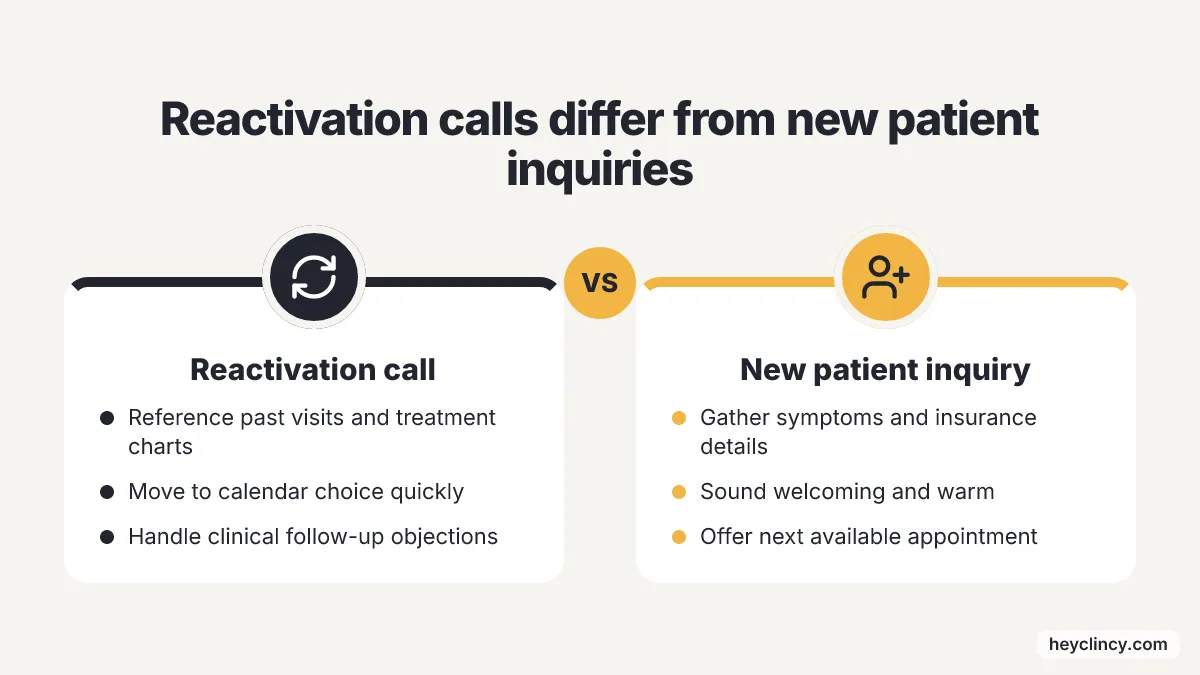
Incoming inquiry conversion works differently from patient recall, yet both depend on the same front-line communication basics. Receptionists need to guide the conversation, ask for a calendar commitment directly, handle hesitation, and lock in the visit details before they hang up. With inactive patients, staff have a clear advantage because they can see past clinical charts, so the script should refer to earlier visits instead of sounding like a cold call.
Firegang fits best in dental practices where the main phone lines are juggling new inquiries and outbound recall lists all day. If an office already books incoming calls reliably, leadership will get stronger results by choosing training centered on hygiene recall, reactivation, or unscheduled treatment follow-up.
6. 1-800-DENTIST: recall and reactivation script examples
1-800-DENTIST call scripts offers a plain reference set with wording for routine recalls and overdue outreach. Front desk staff reach for it when they want sample dialogue before they draft internal scripts for hygiene visits, restorative work, or missed appointments.
A central wording library gives the front desk a steady starting point for patient messages. Teams get the most use from it after they adapt the drafts to fit daily clinic routines. Staff still have to decide who sends the first text, who takes the phone call for follow-up, which clinical codes fit the visit, and where the note goes in the chart.
A call to bring back a hygiene patient goes straight to open times: Taylor, your cleaning is overdue, and Dr. Patel wanted us to call and save an open chair. We have two morning slots open next Tuesday, and I can text both choices to your phone right now.
The collection also works as a first reference for clinics comparing basic wording before outside training. The front desk team still has to write its own replies to fee objections, handle unsubscribe requests from patients, and set chart documentation rules inside Open Dental.
How should a front desk choose a reactivation script?
Dental offices need to find where the recall process actually breaks before they hand staff a fresh phone script. Different practices trip over different things.
- One front desk sounds stiff on calls and needs better sample wording.
- Another team sees booking rates swing hard and needs a manager sitting beside them, coaching calls.
- A clinic with an inbox full of unread text messages has a different problem, because nobody owns the inbox and more outreach only adds more unread replies.
Look closely at the recall lists inside Open Dental. Build outbound wording around one immediate scheduling step, so the caller knows what comes next. Hygiene recalls need a quick choice between two open times.
Incomplete treatment outreach works differently. The patient needs a plain explanation of the planned procedure, a reference to prior chart notes, and a direct handoff to the treatment coordinator. Missed incoming calls call for speed, plus a note on whether staff actually reached the person. If drafting these lines from scratch slows the project, office managers can bring in a Clincy reactivation script template and cross out any line that sounds stiff or robotic when spoken aloud.
A good script handles money and timing objections in the middle of the booking conversation instead of skirting around them. When a patient hesitates over money, the coordinator can say: Dr. Patel noted this restorative visit as your next priority, so I will have our billing coordinator review your copay estimate before we finalize your date. When the schedule is the issue, the reply is plain: I can text two open dates right now and hold the Tuesday slot until four o'clock today. If the patient asks for a callback later, the staff member writes down who owns that follow-up in the appointment book before hanging up.
Automated outreach built with artificial intelligence only works if someone at the desk owns the incoming replies. In March 2026, ADA News announced that ADA Member Advantage granted an ADA endorsement of Weave for its artificial intelligence-driven patient engagement and messaging software, while in April 2026 Weave released AI-powered platform enhancements built for medical and dental clinics. With tools like these in play, dental managers will spend more time weighing script libraries against automated software than comparing static phone sheets.
Clincy offers AI calls and texts built specifically for patient reactivation and unscheduled treatment recovery, starting its integration work around Open Dental. Practices that run Open Dental can review an automated patient reactivation workflow next to an Open Dental reactivation walkthrough, turning incoming patient replies into booked visits on the schedule instead of leaving them as unread notifications.
Always check software compatibility before connecting an outside tool to your practice management system. Open Dental pushed out its stable Open Dental version 26.1 update in August 2026, changing system chat, insurance handling, and API connections, so any communication software tied to Open Dental needs verified version testing. If an automated script gets a patient to say yes but cannot write that confirmation code back into the main ledger, the front desk gets stuck retyping information by hand.
The clinical terms in treatment follow-up scripts need regular checks too. ADA News reported in June 2025 that the CDT Code 2026 changes took effect on Jan. 1, 2026, adding 60 updates to dental procedure codes, so clinics must match their follow-up wording to active procedure descriptions before calling patients about outstanding care. Receptionists do not need to quote billing codes to patients, but treatment coordinators should not have to field callbacks based on outdated clinical terms either.
The most common way script rollouts fall apart is when no one owns incoming messages. Buying scripts or turning on automated dialers without assigning a specific coordinator creates an ignored inbox, and patients notice when one person texts them while another calls an hour later asking the same questions.
- Put one person in charge of the inbox per shift.
- Set clear rules for routing clinical questions to coordinators.
- Make staff log call outcomes before moving to the next contact batch.
Rewriting front desk scripts will not fix an understaffed clinic. Becker's Dental Review reported in October 2026 that rising labor costs represent a major financial strain across dental practices and DSOs, creating hiring friction among front office personnel, clinical assistants, hygienists, and associate dentists. When open appointment slots pile up because an office manager chair sits empty or a hygiene chair has no provider, DDS Recruit dentistry recruiting offers dental staffing services across the country to handle sourcing, applicant screening, interviews, and operational placement. Staffing shortages belong in an evaluating dental recruiting agencies strategy session, not in a rewrite of front desk scripts.
New patient intake calls should never share scripts with overdue patient outreach. A Clincy new patient phone script gathers new symptoms, logs basic insurance details, and offers the next open chair, while reactivation calls rely on previous charts and earlier conversations about treatment. Mixing the two produces cold, mechanical calls that turn off patients who have visited the clinic for years.
How to pilot a new reactivation script
Filter your Open Dental records down to a single inactive patient group and select the script approach that addresses the primary bottleneck within that list. Making this system work requires a clean contact list, approved language, an assigned reply coordinator, and an enforced rule that staff log every call result before reaching out to another cohort.
Run a controlled pilot with twenty overdue hygiene accounts, assign one receptionist to document responses inside patient charts, and record whether the language secures booked dates or stalls on fee questions. Adjust phrases that sound unnatural to your staff, and verify that calendar holds transfer smoothly into the hygiene schedule before rolling the dialogue out across the entire office. Practical front desk scripts guide the conversation toward a reserved appointment, leaving fee plans, clinical alternatives, and diagnosis explanations in the hands of the doctor and treatment coordinator.
Frequently Asked Questions
What are the best dental patient reactivation scripts for front desk staff?
The best dental patient reactivation scripts are those tailored to specific patient segments, booking goals, and reply ownership. Effective scripts address overdue hygiene, unscheduled treatments, missed calls, and objections to cost or timing, ensuring a clear route to a firm date on the schedule.
How can KickStart Dental Marketing help with patient reactivation?
KickStart Dental Marketing provides segmented reactivation campaigns, offering scripts broken out by clinical category. This approach helps practices organize contact lists and tailor conversations to specific patient needs, such as overdue cleanings or unscheduled restorative treatments.
What does Patient Excel offer for front desk reactivation?
Patient Excel offers full front desk conversion training, integrating reactivation conversations into a comprehensive telephone process. This training helps manage outbound recall dialogues, schedule reactivation, and missed call recovery, ensuring clear protocols for answering, screening, scheduling, and charting calls.
How do BoomCloud scripts prevent cancellations?
BoomCloud provides scripts that tie upcoming visits to ongoing oral wellness and preventive checks, helping to reduce last-minute cancellations. These scripts are used alongside recall work to reinforce the importance of scheduled visits and maintain patient engagement.
What resources does 1-800-DENTIST provide for reactivation?
1-800-DENTIST offers a reference set of call scripts for routine recalls and overdue outreach. These scripts serve as a starting point for front desk staff, who can adapt them to fit daily clinic routines and ensure effective patient communication.
Related reading
Sources
- KickStart Dental Marketing – Dental Patient Reactivation & Speed-to-Lead
- Patient Excel – Dental Front Desk Training
- 27 Dental Phone Scripts for Front Desk Success – BoomCloud
- Front Office Academy – Dental Front Office Training
- Firegang – Dental Front Office Training: Turn Phone Calls Into New Patients
- 1-800-DENTIST – Increase Patient Call Conversion with Call Scripts
Clincy keeps treatment conversations moving with personalized texts, human support, and scheduling in your practice management system.
Book CallMore from the blog
6 Best Dental Patient Intake Form Examples to Copy
Compare six dental patient intake examples by language access, online completion, and health history depth before changing your front desk workflow.
Effective Dental Office Text Messaging Templates
Explore text messaging strategies for 1,796 clinics in 567 cities to enhance patient engagement, reduce no-shows, and improve appointment adherence in 2026.